
Julie Heyde
- Lecturer in the ARC: Invisual Art (archived ARC)
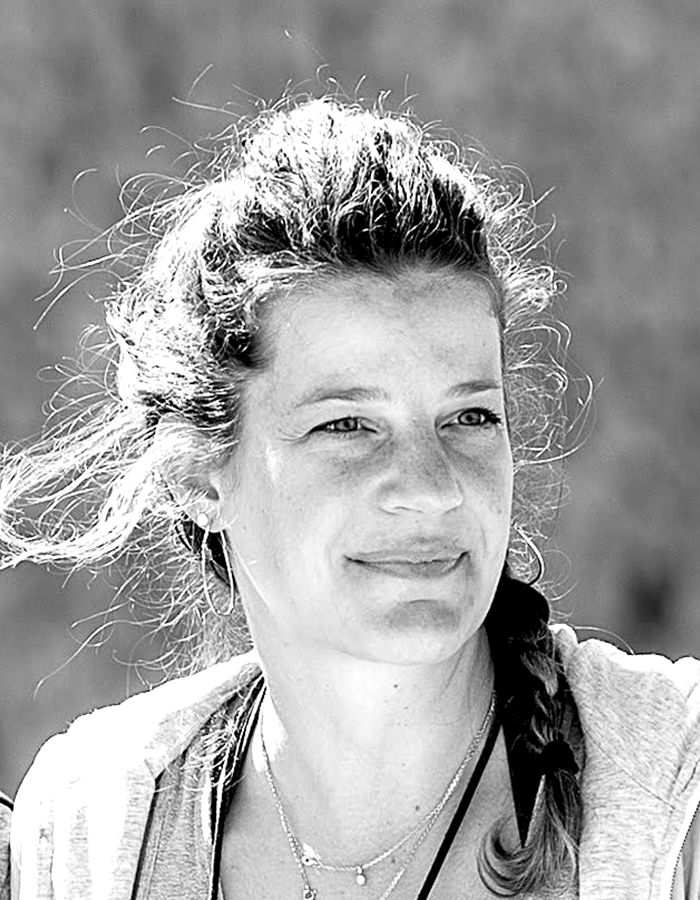
Born in 1983 in Villeurbanne, Julie HEYDE is a writer and an untamed draughtswoman. An architect for 17 years, she imagined and built living spaces before focusing on participatory approaches, supporting residents in becoming collectively involved in the appropriation of commons. She lived in Bordeaux, the Netherlands, Paris and New York before settling in Marseille. She is the mother of two children. She is the author of the novel Partir and of the children’s picture book Lyli & Polis (self-published, 2010). She observes the world and transcribes it in an untamed way with black ink and paper, using languages made up of simple shapes. She carries out automatic writing performances in public space and explores processes of emancipation through the imagination.
Lecture title: L’art de faire lieu, vers une architecture invisuelle [The art of place-making: towards an invisual architecture]
Date: Tuesday 8 April 2025 at 9.00 am (Beirut time)
Format: Hybrid
Venue: Lebanese Academy of Fine Arts, Beirut (ALBA)
Language: French
Audience: Students in the invisual art atelier
![L’art de faire lieu, vers une architecture invisuelle [The art of place-making: towards an invisual architecture]](../../images/Open-Air-Hotel.-Hotel-van-Schaffelaar-1024x684.jpg)
Whereas invisual art lays claim to the absence of the work of art, invisual architecture reveals itself in the disappearance of the act of designing and building according to plans.
What remains, then? The users – all of us!
Invisual architecture is an architecture of use, a living architecture; it is the art of building places through the succession and superimposition of moments of life. The spatial experience becomes a human journey, in which emotions, relationships and interactions take precedence over form.
Invisual architecture is an in-finite architecture, a field of possibilities, a story forever in the process of being written. It is a place where everyone becomes a designer simply by inhabiting it, bringing it to life and loving it.
Together we will explore the movements, past and present, that can be likened to invisual architecture, and discuss the upheaval this implies for the designer, the architect.