
Rose Marie Barrientos

- Lecturer in the ARC: Invisual Art (archived ARC)
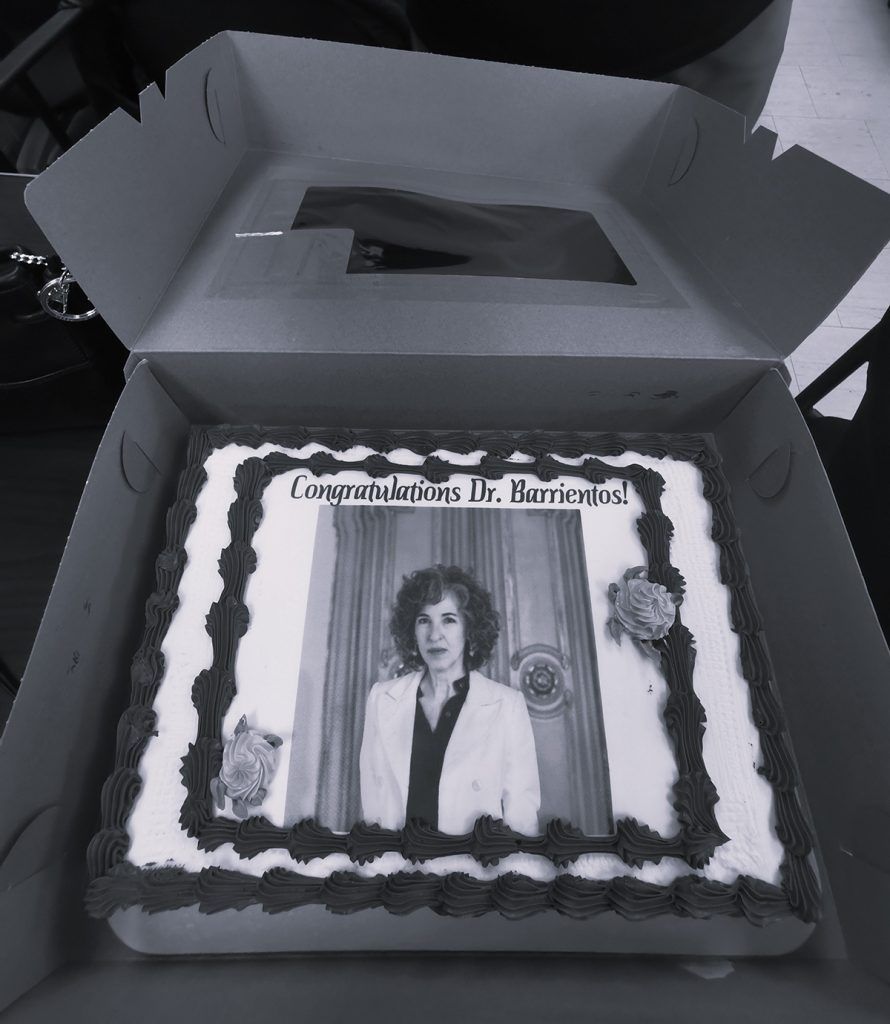
Rose Marie Barrientos, who holds a doctorate in argumentation, examines the possibility of art as argument, starting from a view of art as a form of thought, discourse and knowledge. More specifically, she is interested in artists’ organisations (known as “critical enterprises”), which form the focal point of her research. This argumentalist historian has formulated a methodology based on argumentation, making it possible to write the history of art with instruments borrowed from that discipline. Her approach relies on analysing the argumentation strategies deployed by artists to give meaning to their work, rather than on their production of works, whether visual or invisual in nature. She gives precedence to argumentative elements and to the dynamics of the argument over the form and content that convey it. She is a facilitator at the Ecole nationale d’art de Paris (ENDA), the school of the Biennale de Paris.
Lecture title: Les voies de l’argumentation, la raison de l’art [The paths of argumentation, the reason of art]
Date: Tuesday 15 October 2024 at 2.30 pm (Beirut time)
Format: Hybrid
Venue: Lebanese Academy of Fine Arts, Beirut (ALBA)
Language: French
Audience: Students in the invisual art atelier
By breaking away from the principle of representation as the anchor and central lever of artistic creation, invisual art introduces a new paradigm that has as yet been little studied. How should we approach an art that frees itself from the sensory register in order to favour what belongs to the cultural, philosophical or political sphere? How can it be distinguished from conceptual art and from other, more recent art forms, such as performance and relational aesthetics? Moreover, since its practitioners seek to emancipate themselves from the traditional art world – aesthetically as well as institutionally and economically – one may well ask about its modes of dissemination, reception and interpretation. Yet the interpretive frameworks and methodologies available to art history prove insufficient to address these questions. In the course of my research on “critical enterprises”, this observation steered my thinking towards argumentation, an interdisciplinary field of study offering instruments better suited to my analysis.
Invisual art belongs to a new category, which I propose to identify here by considering it as a vehicle of argumentation in the service of the argumentalist artist (a neologism coined by Alexandre Gurita). In this configuration, art would be an extension of reason. Regarding “critical enterprises” as embryonic forms of invisual art, I outline some avenues that will make it possible to answer the questions raised above; but my presentation also aims to provide some theoretical and historical reference points on argumentation, a discipline now at the heart of my work as an art historian. Its principles inform my hypotheses, which leads me to think that these same principles lie at the heart of invisual practices.
Publications
- BARRIENTOS, Rose Marie. Les entreprises critiques. Éditions de la Sorbonne, Paris 1.