Roxane Vidalon
Artist, Director of the IAPI (Institute of Philosophical and Invisual Art). Researcher in Philosophical and Invisual Art, philosophal artist.
- Lecturer in the ARC: Invisual Art (archived ARC)
Artist, Director of the IAPI (Institute of Philosophical and Invisual Art). Researcher in Philosophical and Invisual Art, philosophal artist.
She is currently pursuing a Master’s in Aesthetic Research (Philosophy and Psychoanalysis of Art) at the University of Montpellier (France). A graduate of the École nationale d’art de Paris (ENDA), she has proposed opening a Line of Research and Experimentation (LDRE) there, entitled “Theoretical and Philosophical Foundations of Invisual Art”, for the year 2025.
She previously taught contemporary dance at the Conservatoire de Tarbes (France), before turning to the visual arts (including tattooing and illustration) from 2016 onwards. In 2018, she committed herself fully to the plastic arts, deepening her research and continuing to nurture philosophical reflection. Her approach had already led her to undertake a bachelor’s degree in philosophy (in 2013) with the aim of merging artistic practice and philosophical reflection. In 2023, Roxane Vidalon decided to set aside the production of artworks in order to devote herself to an in-depth study of art, of matter and of its abstraction. In March 2024, she founded the Institute of Philosophical and Invisual Art (IAPI), whose public launch is to take place the same year. Her latest article, L’Œufre au Rose, was published in the Revue de Paris (No. 54) in February 2024. Her most recent lecture on invisual art, entitled L’art est-il faux ? L’art invisuel comme réponse [Is art false? Invisual art as an answer], was held in July 2024 during the Semaine des Arts de Soueich (Haute-Garonne, Occitanie, France). Recently, an article mentioning the artist’s work, Roxane Vidalon, l’art invisuel pour repousser les limites, by Stéphane Boularand, was published in La Dépêche in May 2024.
Lecture title: Pour un dépassement de l’art : l’Art Philosophique et Invisuel [Towards a transcending of art: Philosophical and Invisual Art]
Date: Tuesday 15 October 2024 at 3.30 pm (Beirut time)
Format: Hybrid
Venue: Lebanese Academy of Fine Arts, Beirut (ALBA)
Language: French
Audience: Students in the invisual art atelier
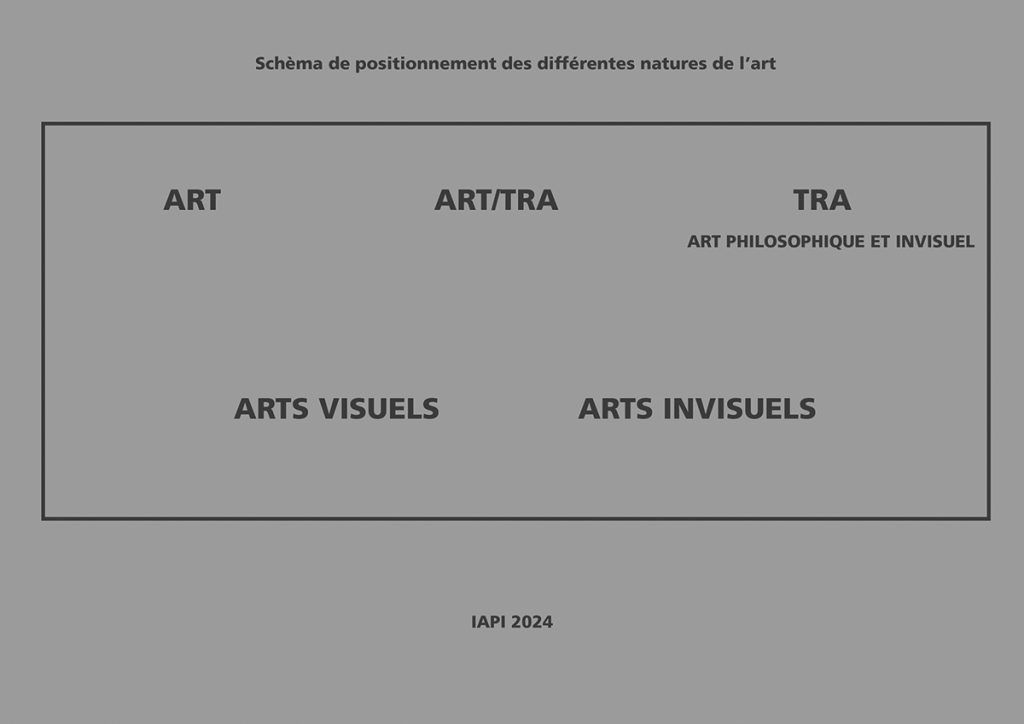
When I understood what invisual art was, it struck me as a major discovery in the history of art and of humanity. I deliberately speak of discovery because it is at last a matter of envisaging art stripped of all its trappings, embellishments and accidents in the philosophical sense, that is to say everything that may not be, as opposed to the essence, the principle, which IS – I would even say which perpetually BECOMES. Art is not a painting, art is not a musical composition, art is not a performance: it BECOMES. And invisual art, by detaching itself from the concepts of the work and the object, comes closer, in my view, to a pure principle of art in the process of becoming – or at least it questions that principle, and sets out to meet it off the well-trodden paths of the visual arts and the performing arts.
I then set out to explore the theoretical foundations of invisual art in greater depth, using a methodology borrowed from philosophy. I named this research, which has become my practice, Philosophical and Invisual Art.
I believe that invisual art must now reach a new stage in its grounding and its expansion; we should even consider that it could then reach an audience outside artistic institutions more effectively, and thus ensure its dissemination and its self-evidence among the population, the doxa and society. It is now a matter of understanding that invisual art is part of the noetic era that humanity has entered since the beginning of the 21st century. The modern and contemporary eras of rationality, capitalism and the object are coming to an end, giving way to an era of thought, of knowledge, of complex synergetic and informational systems: an era in which the old but persistent socio-economic models will be surpassed.
Publications
- VIDALON, Roxane (2024, février). « L’Œufre au Rose ». Revue de Paris, n° 54.