Ateliers (ARC) / ARC Mapping Religiosity in the Suburbs of Beirut
ARC Mapping Religiosity in the Suburbs of Beirut
2024-2025. Semester 1
Atelier for Research and Creation · Semester
- 2024-2025. Semester 1
- Code: ARC1042-1
- Lead teacher-researcher: Michael F. Davie, PhD
- Timetable: Tuesday, 14:30 – 17:30
Course sheet
Title: ARC1042-1 – Cartographier la religiosité dans les banlieues de Beyrouth
If the preview does not display, open the course sheet in a new tab.
Research report
Vernacular Shrines in Beirut and its Eastern Suburbs: a Preliminary Analysis
(Abstract)
Andrea Abdelnour, Chaker Abirached, Ryan Bachaalany, Joseph El Chakhtoura, Perla Geagea, Habib Habib, Carole Hobeika
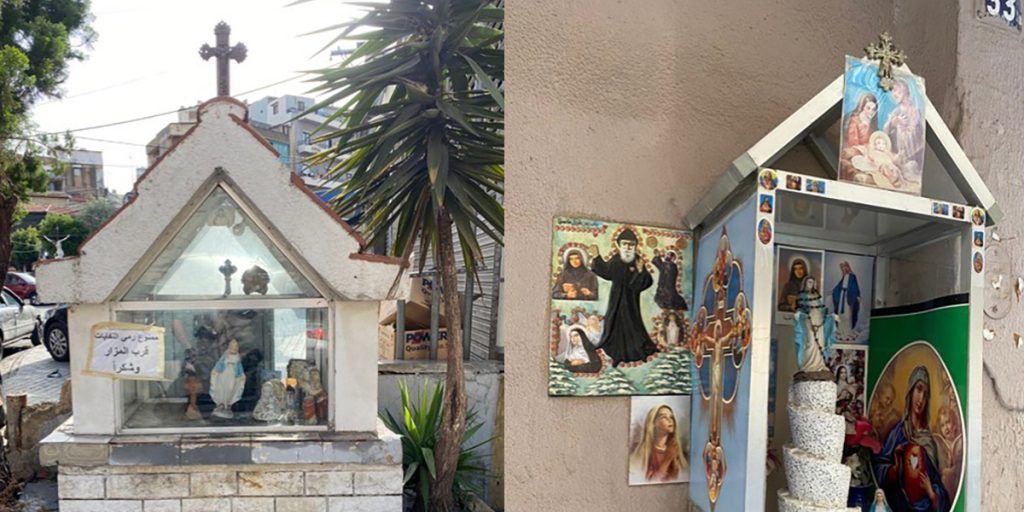
The research was conducted between September and December 2024, in Achrafiyé, Antelias, and Awkar; the results suggest that the mazârs are politically and territorially-grounded, each of them expressing the fears, obsessions, and multifaceted identity crises of the population. They express deep societal anxieties, rooted in uncertainty around both individual and collective existences, amidst persistent political instability and economic hardship.
The proliferation of shrines and religious symbols indicates a shift from being just spiritual aids to objects of compulsive and excessive veneration; they are also politicized, especially in the Ashrafieh area. Here, the mazârs express deep political connotations, honouring neighborhood civil war martyrs, assassinated political leaders or journalists.
The interviews revealed that persons were either attached to the shrines or completely indiferent towards them, but with a reluctance to discuss their reasons, while expressing respect for the shrines due to the religious and political symbols they carried. For these persons, they have become part of the everyday urban landscape and even in the cases when they are never maintained nor cleaned, they remain in place.
It appears that mazârs may be embedded within a web of meanings that intertwine spirituality, local traditions, and personal beliefs. But to disentagle the meanings required overcoming the reluctance of the interviewees when discussing the significance of the shrines. They hold meanings beyond their visible function as religious sites: there is a fine line between religious and non-religious practices, where mazârs occupy a space that blurs conventional categories. The reverence for mazârs could be misconstrued as superstition or incompatible with mainstream religious teachings, adding a layer of complexity to the discourse surrounding them, making them deeply personal and often unrecognized markers of community life. In some cases, mazârs are not merely perceived as religious spaces but as sites of cultural heritage, historical importance, or even of supernatural phenomena. This diversity in perception reflects the broader socio-cultural fabric of Lebanese society, where traditions and modernity coexist and often overlap.
Mazârs as complex signifiers
Firstly, the reluctance of many individuals to discuss the mazârs. Are these sites tied to personal or community-specific sensitivities, or is there a deeper cultural or religious nuance at play? While some communities were more willing to share their stories and insights about mazârs, others remain guarded, perhaps intentionally keeping certain aspects hidden. This hesitancy also reveals a deeper tension within Lebanese society, where religious practices are often intertwined with cultural identity. Additionally, the reluctance to discuss mazârs may stem from a fear of losing their sanctity. This raises an important ethical consideration for researchers: How do we balance the need for academic inquiry with respect for the sacred and the private?
Secondly, mazârs are not merely static relics of religious devotion; they are dynamic spaces where cultural, spiritual, and personal narratives converge. However, this convergence often comes with layers of ambiguity and silence, suggesting that mazârs operate at the intersection of the seen and unseen. The duality of mazârs—as both public landmarks and private sanctuaries—highlights their unique role.
Thirdly, the secretiveness surrounding mazârs could be seen as a form of resistance against the homogenization of religious practices. By maintaining an air of mystery, communities assert their autonomy over these sacred spaces, ensuring that they remain rooted in local traditions or urban identities, and not subsumed by broader societal trends.
Fourthly, the discussion around mazârs challenges us to rethink the boundaries of religious and cultural spaces. The abundance of shrines indicates more than mere religious devotion; it reveals a psychological coping mechanism for communities grappling with existential dread.
Finally, these shrines inadvertently uncovered deeper dimensions of how religiosity permeates the fabric of Lebanese society. As these sacred symbols become increasingly common in the landscape, they risk being perceived as ordinary features of the urban environment, potentially diminishing their intended spiritual and cultural significance.
Conclusion
Religion in Lebanon often serves as a lens through which many social issues are rationalized, yet it simultaneously masks and perpetuates them. From sectarian divides to socio-political inequalities, religious practices and institutions are frequently employed as justifications for structural problems that extend beyond faith itself. The shrines encapsulate this duality: on the one hand, they are revered spaces of wonder, devotion, and community bonding, while on the other hand, their presence underscores the obsessive fears and uncertainties that characterize a society grappling with identity, memory, and belonging. The Lebanese urban and suburban landscapes vividly reflect these contradictions, with Beirut, as a small-scale model of the nation, revealing these layers of complexity. Shrines here are not merely spiritual sites; they are markers of history, territorial identity, and social allegiance. Their locations, often intertwined with historical narratives of martyrdom or miraculous events, become symbolic anchors for communities navigating the uncertainties of modernity.Yet, they also represent an unspoken acknowledgment of fragility, a collective fear of loss, displacement, and erasure that is subtly woven into the act of veneration. The mazârs reinforce community bonds but can also entrench sectarian identities, creating divisions. Psychologically, while offering spaces for solace and reflection, they risk fostering compulsive behaviors that blur the line between genuine faith and excessive ritualism. Politically, shrines serve as markers of sectarian influence, of territorial control by a particular sect or religion, instrumentalized to assert dominance rather than to foster unity.
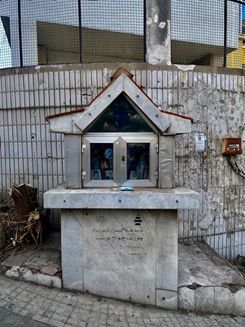
Coordinates: 33o53’19.5’’N , 35o31’34.6’’E
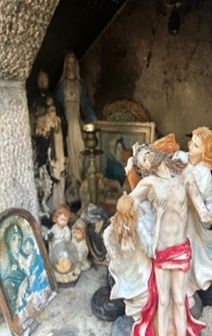
Coordinates: 33.91249° N, 35.58894° E
Lectures
Each lecture is described on the speaker’s page.
- 29 October 2024L’omniprésence du « sacré » dans les espaces publics à Beyrouth [The omnipresence of the “sacred” in public spaces in Beirut]Christiane Sfeir