Ateliers for Research and Creation (ARC)
ARC Photography and Visual Formats in Lebanon
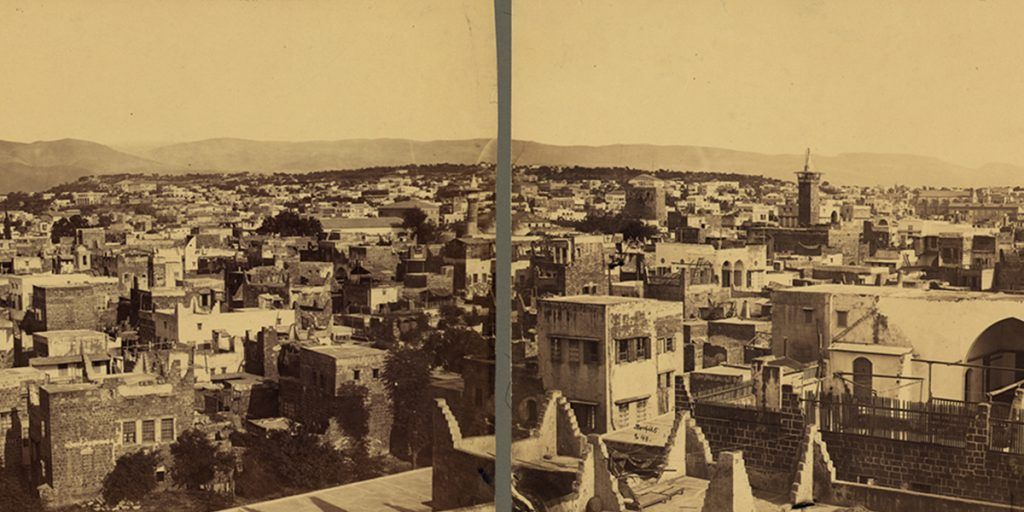
Photo taken by the Maison Bonfils between 1867 and 1899, from the Library of Congress, Washington: https://www.loc.gov/pictures/item/2004668095/
Atelier for Research and Creation
- From September 2024
- Directed by Carine Chelhot Lemyre, PhD
Code: ARC1044-1
Lead teacher-researcher
Carine Chelhot Lemyre, PhD
carine.lemyre@alba.edu.lb
Start date: September 2024
Description
The study and interpretation of photography in the Middle East and North Africa (or what was then the Ottoman Empire) form a developing field for tracing the history of the European photographers who “explored” the region, as well as of those who chose to set up local studios. While recent research has been published on a number of them, the history of a significant proportion of the French studios established in Lebanon, and of other local ones, remains undocumented.
This atelier aims to address the main historical, conceptual, theoretical and aesthetic questions that inform the history of photography in the Middle East and Lebanon, from the medium’s beginnings in the mid-19th century to the early 20th century. Let us explore the photographic materials of these studios and analyse how the content of these photographic illustrations interacted with their viewers, depending on the format in which they were produced.
The atelier will include visits to local archives such as the Fouad Debbas Collection at the Nicolas Ibrahim Sursock Museum. The students’ written assignments will be based on photographic material consulted in person in these archives.
This atelier would be of interest to all Master’s students with a particular interest in photography, the history of visual technologies, modes of viewing and photographic formats of the late 19th and early 20th centuries. As we live in a hyper-visualised world, it is always worthwhile to reflect on the history of image production and on the ways in which images were disseminated, sold and received by various audiences.
Context
Although the Maison Bonfils (1867-1914) was the most renowned commercial studio in Beirut in the 19th century, it was contemporary with other lesser-known studios, both French and locally run, such as those of Jean-François Charlier, Tancrède Dumas and the Sarrafian Brothers. The photographic materials of these studios, produced in different photographic formats such as stereographs, magic lantern slides, panoramas, postcards and albums, are held in the Fouad Debbas Collection at the Nicolas Ibrahim Sursock Museum, the Jafet Library Collection at AUB, and other private collections.
Given this significant number of local studios, new avenues of research on 19th-century photography in the Middle East, and in Lebanon more specifically, could extend not only to discussions of the relationship between photographic formats, their content and their reception, but also to a study of the studios in Beirut with which Félix Bonfils, the head of the Maison Bonfils, is believed to have collaborated. Such archival research could potentially lead to an exploration of a network of photographers in 19th-century Beirut, of which the Maison Bonfils was a crucial part.
More specific learning outcomes
- Develop skills in the visual analysis of early photographs, taking into account their formal properties and their contexts, such as the daguerreotype, the calotype, the albumen print, etc.
- Understand and explore the relationship between the different photographic formats and the reception of images, which itself depends on the photographic format.
- Encourage critical thinking and the evaluation of historical materials, both in their digital form and in their physical form during visits to local archives.
- Improve research skills through the use of library and electronic resources.
- Improve essay-writing skills and the coherent synthesis of research findings in support of an argument.
- Encourage the presentation of ideas to others during open discussions.
Atelier objectives
- Study the diverse uses of photography in social, political and historical contexts, as well as the aesthetic and pictorial means employed to achieve these aims in imperial and colonial contexts in the 19th century.
- Develop a sound appreciation of 19th-century photography in the Middle East and analyse the pictorial aspects, styles and methods employed by a good number of the studios.
- Gain an understanding of the main technical innovations in the history of photography and of their specific socio-historical contexts.
- Develop an appreciation of the different formats of early photographs and their social contexts: daguerreotypes, stereographs, magic lantern slides, albumen prints, photographic albums, postcards.
- Examine the role of the camera and of photography in imperialist and colonial contexts.
- Gain an understanding of the contemporary theoretical perspectives adopted to discuss historical photographs.
- Learn more about the photographic studios that were once active in Lebanon. Who were they? How did they operate?
Research questions and problem statement(s)
Who were the other studios, what materials did they produce, in which formats, and what were the trends and tastes to which they responded? Were these trends Orientalist? Can they be labelled as such, or would it be clichéd and too general to describe them as Orientalist? Were other local individuals involved in the production of these photographic materials?
Research hypothesis
We have a general idea of which studios were operating in Lebanon in the 19th century, but the analysis of and commentary on the material produced remain abstract, vague and general. Personally, I have carried out in-depth research on the Maison Bonfils in several archives in Lebanon, France, Canada and the United States, but not on the other studios active in Lebanon.
I have learned, in the course of discussions with archivists and collectors, that photographs produced by these other 19th-century studios are held in the Fouad Debbas Collection at the Nicolas Ibrahim Sursock Museum and in the Bibliothèque Orientale of USJ. I assume that the photographers responded to different trends and preferences, but it would be interesting to take a hands-on approach, to be able to see and interact with these photographic documents in person with the students.
I also hypothesise that the material was produced in various photographic formats. Let us see what these formats were – were they albums, magic lantern slides, stereographs, postcards? What were the relationships between the images depicted and the format through which those images were offered and represented? Were they represented in educational and pedagogical contexts (for example, magic lantern devices), or in tourist contexts (in the case of postcards)?
Methodology
Our research will be based on material from a single collection, the Fouad Debbas Collection, as this is more practical and, to my knowledge, it is the collection that holds the largest number of photographs from local studios in Lebanon. Should there be interest in other photographs archived in the collections of the Jafet Library at AUB, these are digitised and can be consulted online. There are also postcards by the Sarrafian Brothers digitised on the British Library website. The various disciplines involved in this research project include art history, history, the history of photography and archival practices.
Through the examination and study of the photographs produced by the local studios of Beirut, we could establish how Lebanon and the Middle East were represented by these studios and through which formats. Interviews with the archivist of the Debbas Collection will therefore be necessary to access these photographs, as well as with historians of 19th-century photography, in order to gain different points of view and generate conversations. When the students and I feel that we have seen and had access to enough material to analyse and study, we will stop the visits to the archives and begin discussing the material collected, thereby establishing hypotheses and answers to our research questions.
Expected results
One of the main objectives of this atelier is to analyse and discuss photographic documents never seen before in the two collections. I expect to find albumen prints, magic lantern slides, stereographs, postcards and photographic albums from different studios that were in business in Beirut, run by both local and European photographers, among them the Maison Bonfils and the studio of Jean Baptiste Charlier.
I assume that the photographic material to be found was mainly commercial in nature and met the demands of the late 19th- and early 20th-century market in Europe and the United States, since this material was produced in the Ottoman Empire but sold abroad. The involvement of specialists in the field, such as archivists and researchers interested in the history of photography, will bring valuable perspectives to the discussions on the material found in the archives. Reference to academic texts will also enrich the perspective on the objects found.
Assessment
- Attendance
- Following the CRC lecture series
- Atelier assignments
- Research essay
References
- Aubenas, Sylvie, and Jacques Lacarrière. Voyage en Orient. Paris: Bibliothèque nationale de France, 1999.
- Batchen, Geoffrey. Burning with Desire: The Conception of Photography. Cambridge: MIT Press, 1997.
- Behdad, Ali. Camera Orientalis: Reflections on Photography of the Middle East. Chicago, Ill.: University of Chicago Press; London, 2016.
———. “Mediated Visions: Early Photography of the Middle East and Orientalist Network.” History of Photography 41, no. 4 (October 2, 2017): 362–75.
———. “Orientalist Desire, Desire of the Orient.” French Forum 15, no. 1 (1990): 37–51.
———. “The Orientalist Photograph.” In Camera Orientalis: Reflections on Photography of the Middle East, 17–40. Chicago: University of Chicago Press, 2015.
———. “The Orientalist Photograph: An Object of Comparison.” Canadian Review of Comparative Literature / Revue Canadienne de Littérature Comparée 43, no. 2 (2016): 265–81. - Behdad, Ali, and Luke Gartlan. Photography’s Orientalism New Essays on Colonial Representation. Los Angeles: Getty Research Institute, 2013.
- Bustarret, Claire. Le Grand Tour Photographique Au Moyen-Orient: 1850-1880, de l’Utopie Au Stéréotype. Paris: CNRS Éditions, 1995.
- Claudet, Laura. “Stereoscopy.” In Encyclopedia of Nineteenth-Century Photography Vol. 1, edited by John Hannavy, 1338–40. New York: Taylor & Francis Group, 2008.
- Crary, Jonathan. Techniques of the Observer: On Vision and Modernity in the Nineteenth Century. Cambridge, MA: MIT Press, 1992.
- Darrah, William C. Cartes de Visite in Ninteenth Century Photography. Gettysburg, Pennsylvania: W.C. Darrah Publisher, 1981.
———. The World of Stereographs. Nashville: Land Yacht Press, 1997.
Debbas, Fouad. Des Photographes À Beyrouth: 1840-1918. Paris: Marval, 2001.
———. Beirut, Our Memory: A Guided Tour Illustrated with Postcards. Beirut, Lebanon: César Debbas & Fils, 1986. - El Hage, Bader. Damascus a Photographic Journey 1840 1918. Beirut: Kutub Ltd, 2019.
- El Hage, Badr, and Samir Moubarak. Beirut 1840-1918: A Visual and Descriptive Portrait. Beirut: Kutub Ltd., 2022.
- Fani, Michel. Une Histoire de La Photographie Au Liban: 1840-1944. Beyrouth: Éditions de l’escalier, 2005.
- Fleig, Alain. Rêves de Papier: La Photographie Orientaliste, 1860-1914. Neuchâtel: Ides Et Calendes, 1997.
- Gavin, Carney E S. The Image of the East: Nineteenth-Century near Eastern Photographs by Bonfils: From the Collections of the Harvard Semitic Museum. Chicago: University Of Chicago Press, 1982.
- Gavin, Carney E S, and Evelyn Hofer. Bonfils and the Early Photography of the near East. S.L.: S.N, 1978.
- Graham-Brown, Sarah. Images of Women: The Portrayal of Women in Photography of the Middle East, 1860-1950. New York: Columbia University Press, 1988.
- Hannoosh, Michele. “Practices of Photography: Circulation and Mobility in the Nineteenth-Century Mediterranean.” History of Photography 40, no. 1 (January 2, 2016): 3–27.
- Hanssen, Jens. Fin de Siècle Beirut: The Making of an Ottoman Provincial Capital. Oxford: Clarendon Press, 2005.
- Holmes, Oliver Wendell. “The Stereoscope and the Stereograph.” The Atlantic Monthly, June 1859.
- Jammes, Marie Thérèse and André Jammes. En Egypte Au Temps de Flaubert: 1839-1860, Les Premiers Photographes. Paris: Kodak-Pathé, 1980.
- Kassir, Samir. Beirut. Berkeley: University of California Press, 2011.
- Khemir, Mounira. L’orientalisme: L’Orient Des Photographes Au XIXe Siècle. Paris: Nathan, 2001.
- Krauss, Rosalind. “Photography’s Discursive Spaces: Landscape/View.” Art Journal 42, no. 4 (1982): 311.
- Newhall, Beaumont. The History of Photography: From 1839 to the Present. New York: Museum of Modern Art, Boston, 2012.
- Pellerin, Denis. La Photographie Stéréoscopique Sous Le Second Empire. Paris: Bibliothéque Nationale de France, 1995.
- Peltre, Christine. Orientalism. Paris: Terrail, 2004.
- Renié, Pierre-Lin. “Bonfils, Félix-Adrien (1831-1885), Marie-Lydie Cabanis (1837-1918), and Adrien (1861-1929) French Photographers and Photo Publishers.” In Encyclopedia of Nineteenth-Century Photography, 173–74. London: Routledge, 2007.
- Rouillé, André. L’empire de La Photographie: Photographie et Pouvoir Bourgeois, 1839-1870. Paris: Sycomore, 1982.
- Said, Edward W. Culture and Imperialism. London: Vintage, 2007.
- Sheehi, Stephen. “Beyond Orientalism toward a History of Indigenista Photography in the Arab World.” In The Handbook of Photography Studies, edited by Gil Pasternak, 353–69. London: Routledge, 2020.
———. The Arab Imago: A Social History of Portrait Photography, 1860-1910. Princeton: Princeton University Press, 2016. - The Fouad Debbas Collection. “About the Fouad Debbas Collection,” n.d. Accessed December 1, 2022.
- The Library of Congress. “About This Collection | Stereograph Cards | Digital Collections | Library of Congress,” 2015. https://www.loc.gov/collections/stereograph-cards/about-this-collection/.
- Woodward, Michelle L. “Between Orientalist Clichés and Images of Modernization.” History of Photography 27, no. 4 (December 2003): 363–74.
In addition to these references, the Sursock Museum library holds numerous books on photography and its history. Pages 143 to 146 of this online catalogue include sources relevant to this atelier, as well as on other subjects that may be of interest to students. See: https://pay.sursock.museum/upload/8777website2024-Jan-Sursock-Museum-Book-Catalog.pdf
Summary of previous studies and gaps in the literature
There is a wealth of general information available on various European studios that operated in the Middle East or captured images of the region, including figures such as Roger Fenton, Maxime Du Camp, Francis Frith and many others. However, specific studies on individual studios or photographers, particularly local ones, are notably lacking, with the exception of the book written by Stephen Sheehi, The Arab Imago, published in 2016. In his work, Sheehi adopts a sociological and anthropological perspective to analyse the photographs, exploring how these images contributed to the representation of the self and the family in the sociological context of their production. Despite the existence of two books by Debbas and Michel Fani, the Fouad Debbas Collection at the Nicolas Ibrahim Sursock Museum and that of the Bibliothèque Orientale hold a substantial quantity of material that requires in-depth academic and practical analysis.
Indeed, these works on photographers do not sufficiently take into account the various formats in which their photographic material was created, and how the reception of each format depended on its intended “visual treatment”. For example, a stereograph requiring a stereoscope, an album designed for individual viewing with pages turned in a chronological or specific order, and magic lantern slides intended for collective viewing.
Required materials
- Laptop, iPad or other tablet for those who do not have a laptop
- Notebook
- Pencil or ballpoint pen for note-taking
- Notebook and graphite pencil only during archive visits; ink pens, fountain pens, ballpoint pens, etc. are not permitted in the archive space.
Action plan
The project is expected to span two semesters. It will begin with a visit to the archives of the Debbas Collection at the Nicolas Ibrahim Sursock Museum and/or other archives holding photographic material from the studios mentioned above. We will observe and study the material of the Debbas Collection at the Nicolas Ibrahim Sursock Museum, and the students will familiarise themselves with the material observed, as well as with the academic literature on the history of 19th-century photography, Orientalism and Orientalist photography. Ultimately, this in-depth study will lead to an academic publication to be submitted to an academic or other journal. The project will last two semesters because the students will need enough time to examine the material, understand it and situate it in its historical context with the help of the assigned academic readings, and, finally, enough time must also be set aside for writing an academic publication.
Schedule
Session 1
- Introduction to the ARC
- Explanation of expectations of the students.
- Review and viewing of existing references, with an emphasis on relevant interdisciplinary work.
- Formulation of interdisciplinary research questions.
- Establishing the research problem in the context of artistic interdisciplinarity.
- Readings: [bibliographic reference]
- Number of hours: 3 hours
- Independent work: 8 hours
Session 2
- Refinement of the research questions, exploring the connections between the different disciplines.
- Development of the research hypothesis, integrating theoretical and practical elements.
- Readings: [bibliographic reference]
- Number of hours: 3 hours
- Independent work: 8 hours
Sessions 3 and 4
- Visit to the Debbas Collection at the Nicolas Ibrahim Sursock Museum (session 3).
- Data collection: interviews with professionals from different disciplines.
- Note-taking and recording of the interviews for in-depth analysis.
- Observation of interdisciplinary artistic events, with an emphasis on interactions and reciprocal influences (session 4).
- Documentation of the observations and recording of relevant elements to inform the theoretical and practical research.
- Readings: [bibliographic reference]
- Number of hours: 3 hours per session
- Independent work: 8 hours per session
Sessions 5 and 6
- Analysis of the data collected following the archive visits.
- Grouping of emerging themes and patterns, taking interdisciplinary aspects into account.
- Interpretation of the results in relation to the research hypothesis, taking into account the contributions of the different disciplines concerned.
- Identification of the links between theoretical and practical data for a comprehensive understanding.
- Reflection on the interdisciplinary implications of the results and their impact on artistic creation.
- Synthesis of the results of the analysis and discussion of the implications for art, highlighting the synergies and challenges related to artistic interdisciplinarity.
- Mid-term assessment
- Readings: [bibliographic reference]
- Number of hours: 3 hours per session
- Independent work: 8 hours per session
Sessions 7 and 8
- Presentation of each student’s research and/or creative projects.
- Production of the theoretical research articles.
- Production of the practical creative works.
- Readings: [bibliographic reference]
- Number of hours: 3 hours per session
- Independent work: 8 hours per session
Sessions 9 and 10
- Finalisation of the research project: revision, editing and preparation for presentation or publication, highlighting the contributions of interdisciplinarity to theoretical research and practical creation.
- Writing the conclusion of the research project, highlighting the interdisciplinary findings and practical recommendations to support artistic interdisciplinarity.
- Final submission
- Readings: [bibliographic reference]
- Number of hours: 3 hours per session
- Independent work: 8 hours per session
Language of instruction
- French
- English (if needed)
Breakdown of hours
- On-site teaching/research hours = 30 hours
- Independent work = 80 hours
Group size
- Ten first-year Master’s students
Facilitators
2024-2025. Semester 1
2024-2025. Semester 2
Semesters
- 2024-2025. Semester 1Course sheet – 2024-2025. Semester 1 (PDF, 152 KB)Facilitated sessions →
- 2024-2025. Semester 2Course sheet – 2024-2025. Semester 2 (PDF, 172 KB)Lectures →Facilitated sessions →
- 2025-2026. Semester 1Course sheet – 2025-2026. Semester 1 (PDF, 177 KB)
- 2025-2026. Semester 2Course sheet – 2025-2026. Semester 2 (PDF, 182 KB)
- 2026-2027. Semester 1Course sheet – 2026-2027. Semester 1 (PDF, 183 KB)