Intelligent Things – From Prompts to Ghosts
Webinar
- Date: Friday, April 17, 2026
- Time: 4:00 – 8:30 PM, Beirut time
- Venue: Lebanese Academy of Fine Arts (ALBA – University of Balamand), Beirut, Lebanon
- Webinar curator: Samer Eid
Rationale
“INTELLIGENT THINGS − from prompts to ghosts” approaches artificial intelligence as a transformative condition that reshapes the grammar through which architectural and creative practices ideate, project and mediate spatial and cultural realities. Beyond the adoption of new tools, the webinar addresses the emergence of an epistemic configuration, a regime of thought in which prompts operate as acts of orientation, hosts function as devices of distributed agency, and ghosts materialize as spectral traces of data, simulation, and predictive abstraction within experimental production.
For architecture students and learners across the creative sectors, it provides a critical framework to grasp how intelligent systems reorganize relations between author and process, intuition and computation, image and structure, into speculative design positions. The event clarifies how AI participates in modelling environments, shaping imaginaries, and redefining professional trajectories. What emerges is a space of conceptual recalibration where participants may situate their practice within a field of co-produced intelligence, evolving forms, and heightened cultural responsibilities.
Conceived as a trilogy, the “INTELLIGENT THINGS” webinar articulates three successive states of intelligence, as follows:
- language [“prompts”]
- operative embodiment [“hosts”]
- latent worlds [“ghosts”]
Organization
A webinar by the School of Architecture of the Lebanese Academy of Fine Arts (ALBA – University of Balamand) in collaboration with the Centre for Research and Creation (CRC).
- DeanProf. Fadlallah DagherLebanese Academy of Fine Arts – University of Balamand
- DirectorDr. Gaby Issa-El-KhourySchool of Architecture
- Coordinator of the webinarSamer EidArchitect; Member, AI Team (CRC); Senior Lecturer, School of Architecture, ALBA – University of Balamand (UOB)
- DirectorDr. Ricardo MbarkhoCentre for Research and Creation
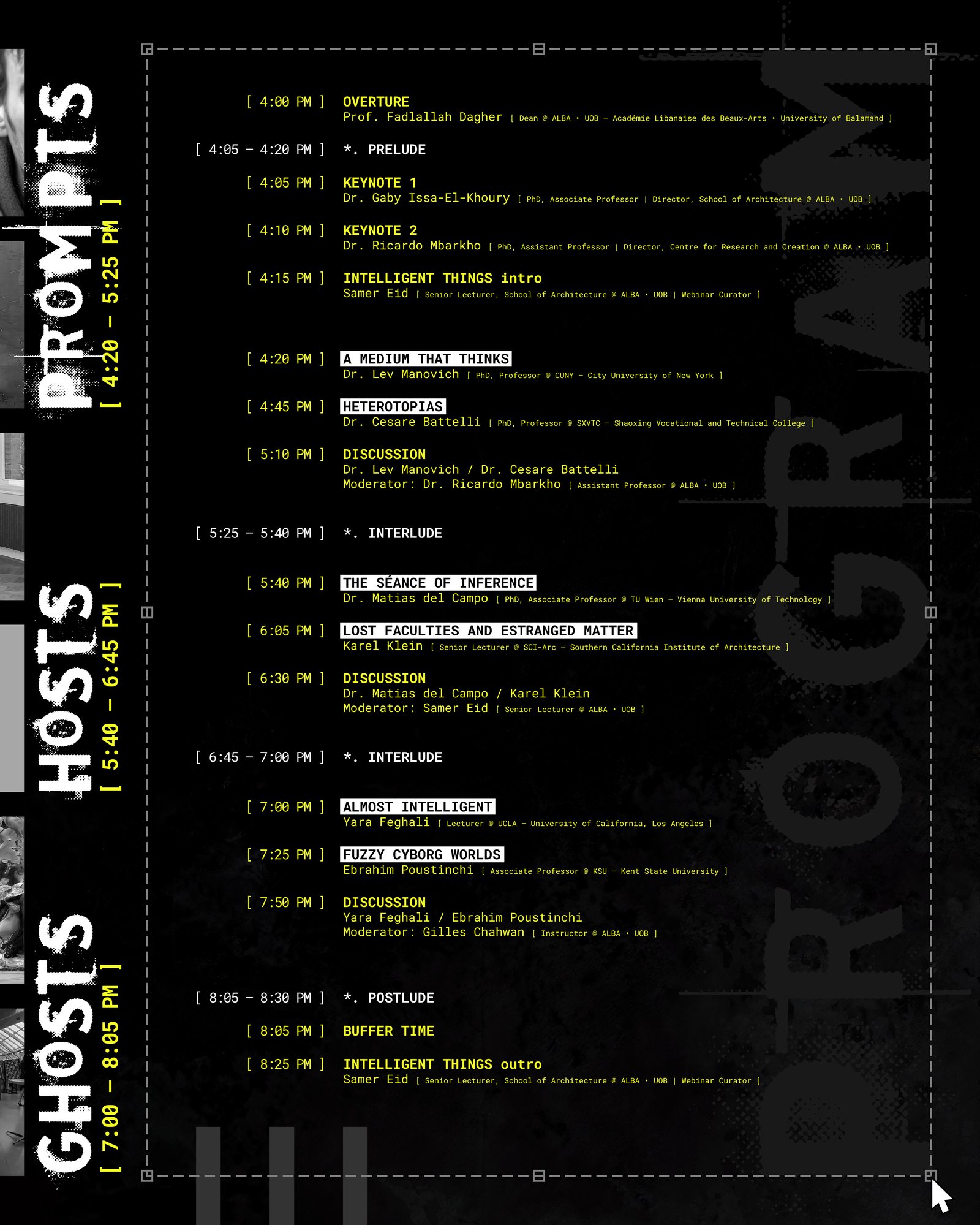
Program
Friday, April 17, 2026, 4:00 – 8:30 PM, Beirut time.
Overture · 4:00pm – 4:05pm
- 4:00pm – 4:05pmOvertureProf. Fadlallah Dagher, Dean, Académie Libanaise des Beaux-Arts @ ALBAUOB
Prelude · 4:05pm – 4:20pm
- 4:05pm – 4:10pmKeynote 1Dr. Gaby Issa-El-Khoury, PhD, Associate Professor | Director, School of Architecture @ ALBAUOB
- 4:10pm – 4:15pmKeynote 2Dr. Ricardo Mbarkho, PhD, Assistant Professor | Director, Centre for Research and Creation @ ALBAUOB
- 4:15pm – 4:20pmINTELLIGENT THINGS introSamer Eid, Senior Lecturer, School of Architecture @ ALBAUOB, Webinar Curator
I. Prompts · 4:20pm – 5:25pm
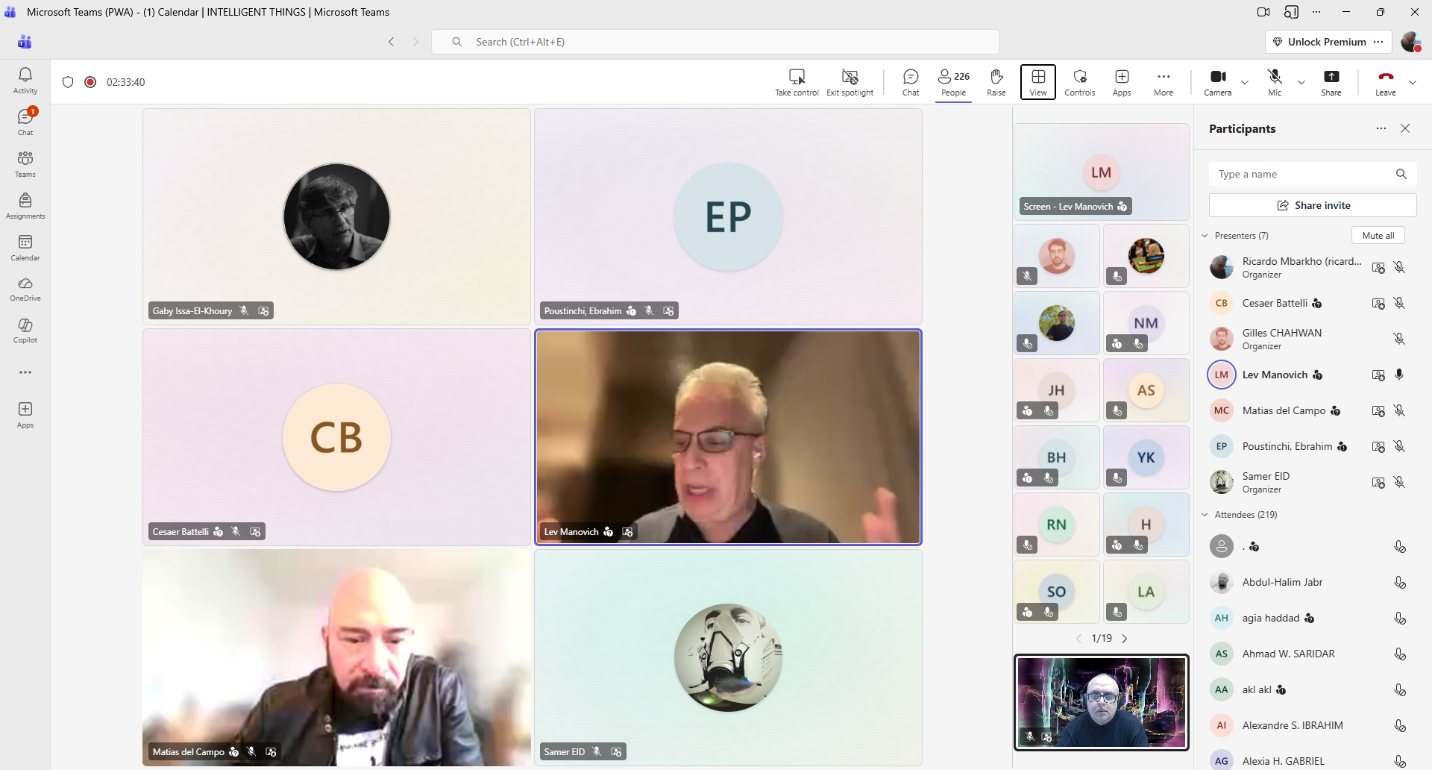
- 4:20pm – 4:45pmA Medium That ThinksDr. Lev Manovich, PhD, Professor @ CUNY − City University of New York
- 4:45pm – 5:10pmHeterotopiasDr. Cesare Battelli, PhD, Professor @ SXVTC − Shaoxing Vocational and Technical College
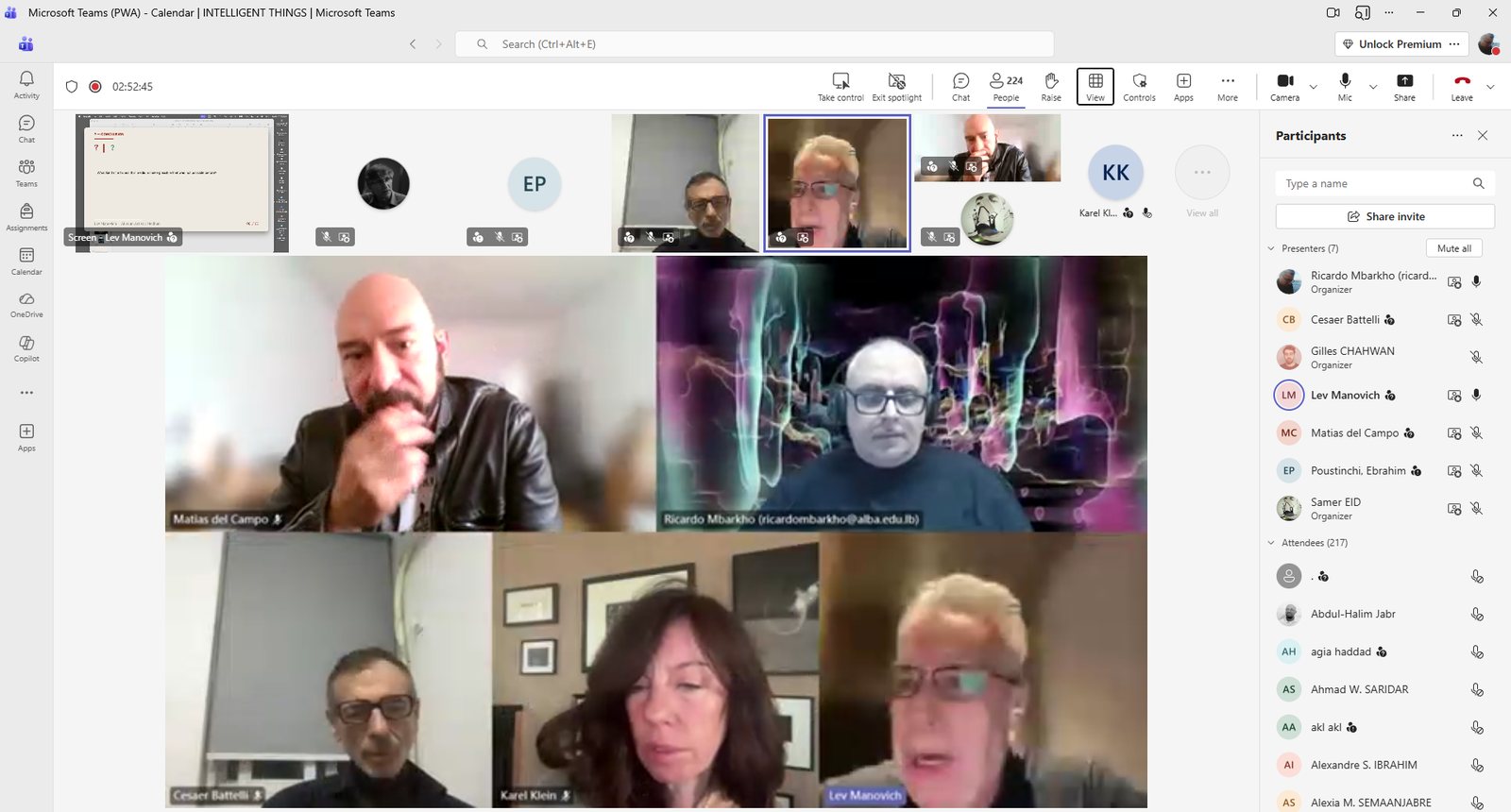
- 5:10pm – 5:25pmDiscussion: Dr. Lev Manovich / Dr. Cesare BattelliModerator: Dr. Ricardo Mbarkho, Assistant Professor @ ALBAUOB
This first panel establishes the theoretical foundations of the webinar: the prompt as a founding act, a linguistic interface between human intention and machine interpretation.
- 5:25pm – 5:40pmInterlude
II. Hosts · 5:40pm – 6:45pm
- 5:40pm – 6:05pmThe Séance of InferenceDr. Matias del Campo, PhD, Associate Professor @ TU Wien − Vienna University of Technology
- 6:05pm – 6:30pmLost Faculties and Estranged MatterKarel Klein, Senior Lecturer @ SCI-Arc − Southern California Institute of Architecture
- 6:30pm – 6:45pmDiscussion: Dr. Matias del Campo / Karel KleinModerator: Samer Eid, Senior Lecturer @ ALBAUOB
This panel addresses the central question of embodiment: how AI becomes a host for the architectural project – and vice versa.
- 6:45pm – 7:00pmInterlude
III. Ghosts · 7:00pm – 8:05pm
- 7:00pm – 7:25pmAlmost IntelligentYara Feghali, Lecturer @ UCLA − University of California, Los Angeles
- 7:25pm – 7:50pmFuzzy Cyborg WorldsEbrahim Poustinchi, Associate Professor @ KSU − Kent State University
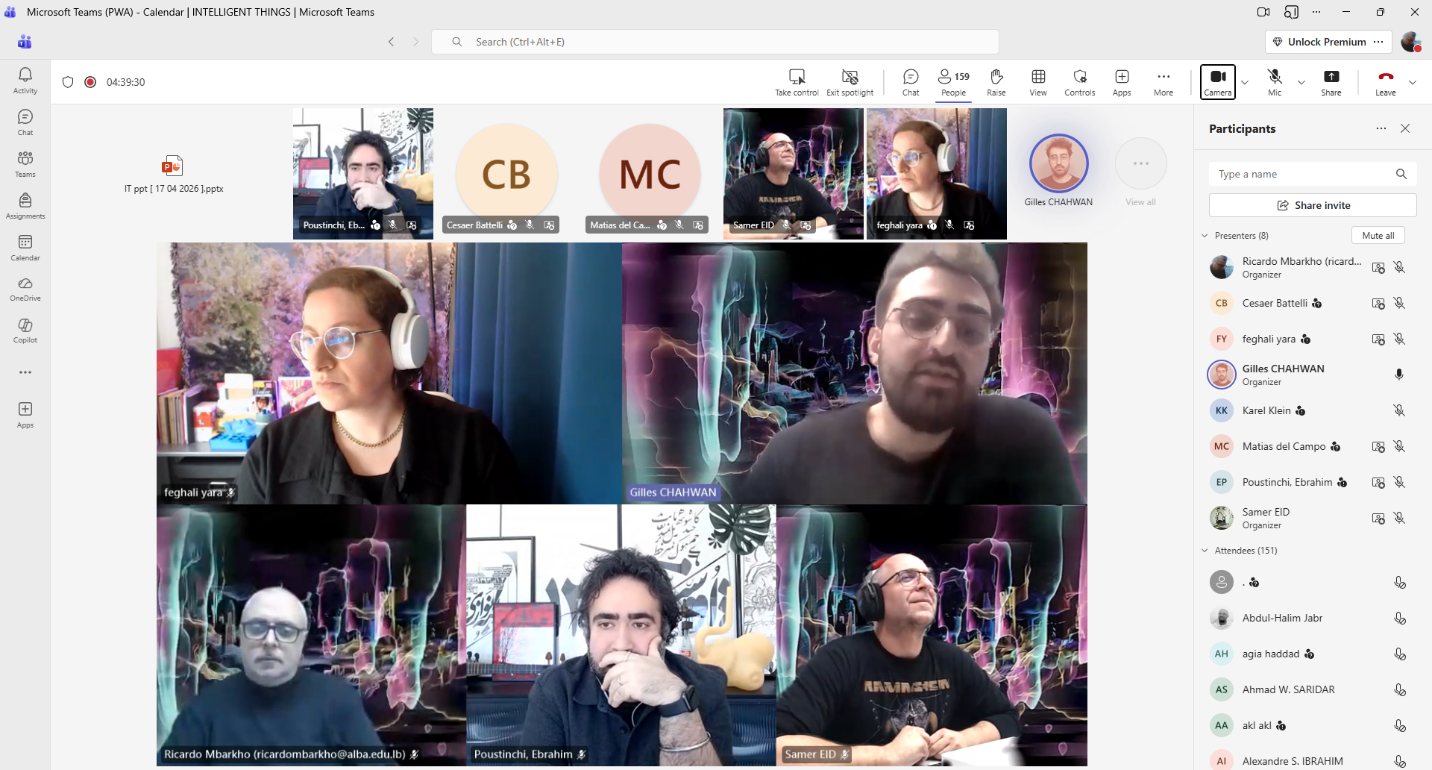
- 7:50pm – 8:05pmDiscussion: Yara Feghali / Ebrahim PoustinchiModerator: Gilles Chahwan, Instructor @ ALBAUOB
This final panel focuses on emergent intelligences and latent worlds.
Postlude · 8:05pm – 8:30pm
- 8:05pm – 8:25pmBuffer time
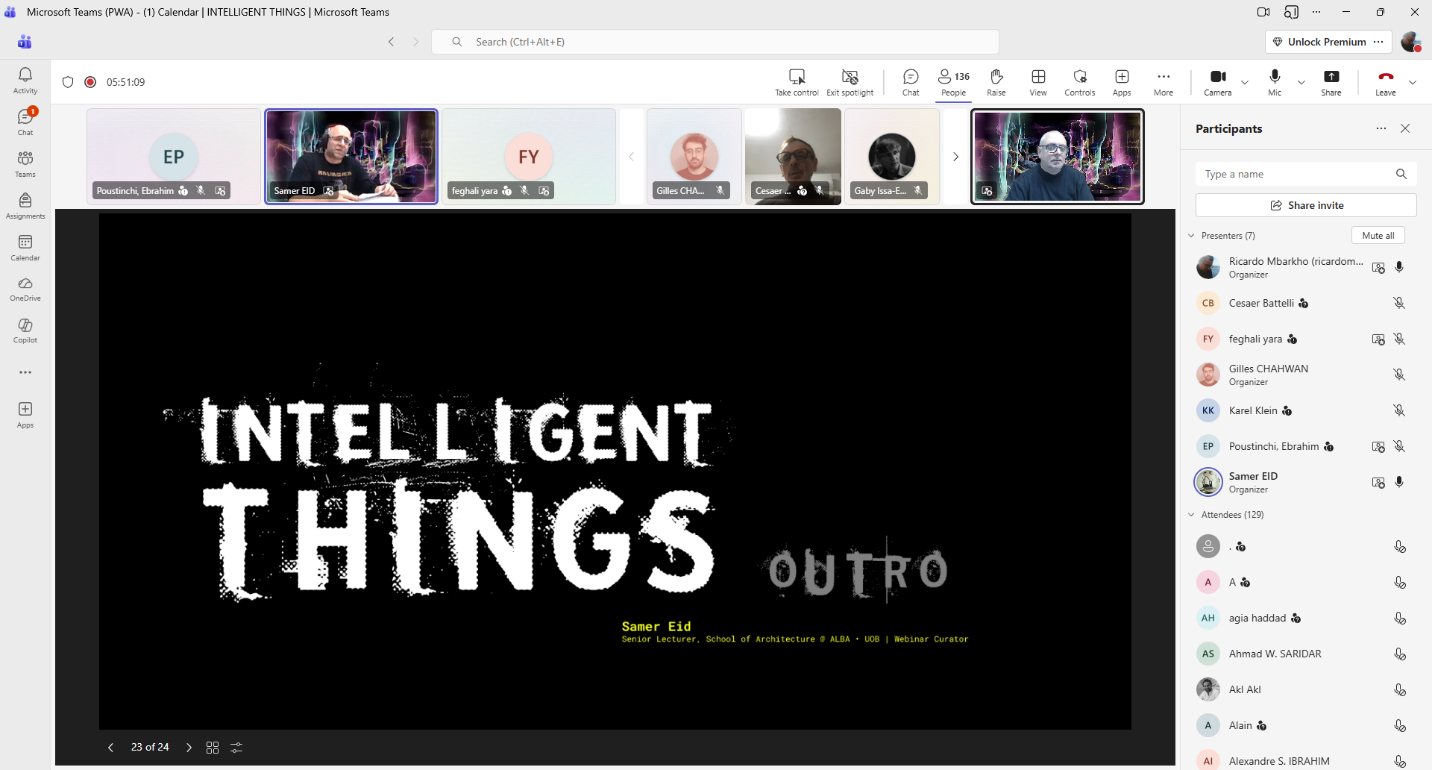
- 8:25pm – 8:30pmINTELLIGENT THINGS outroSamer Eid, Senior Lecturer, School of Architecture @ ALBAUOB, Webinar Curator
Flyer
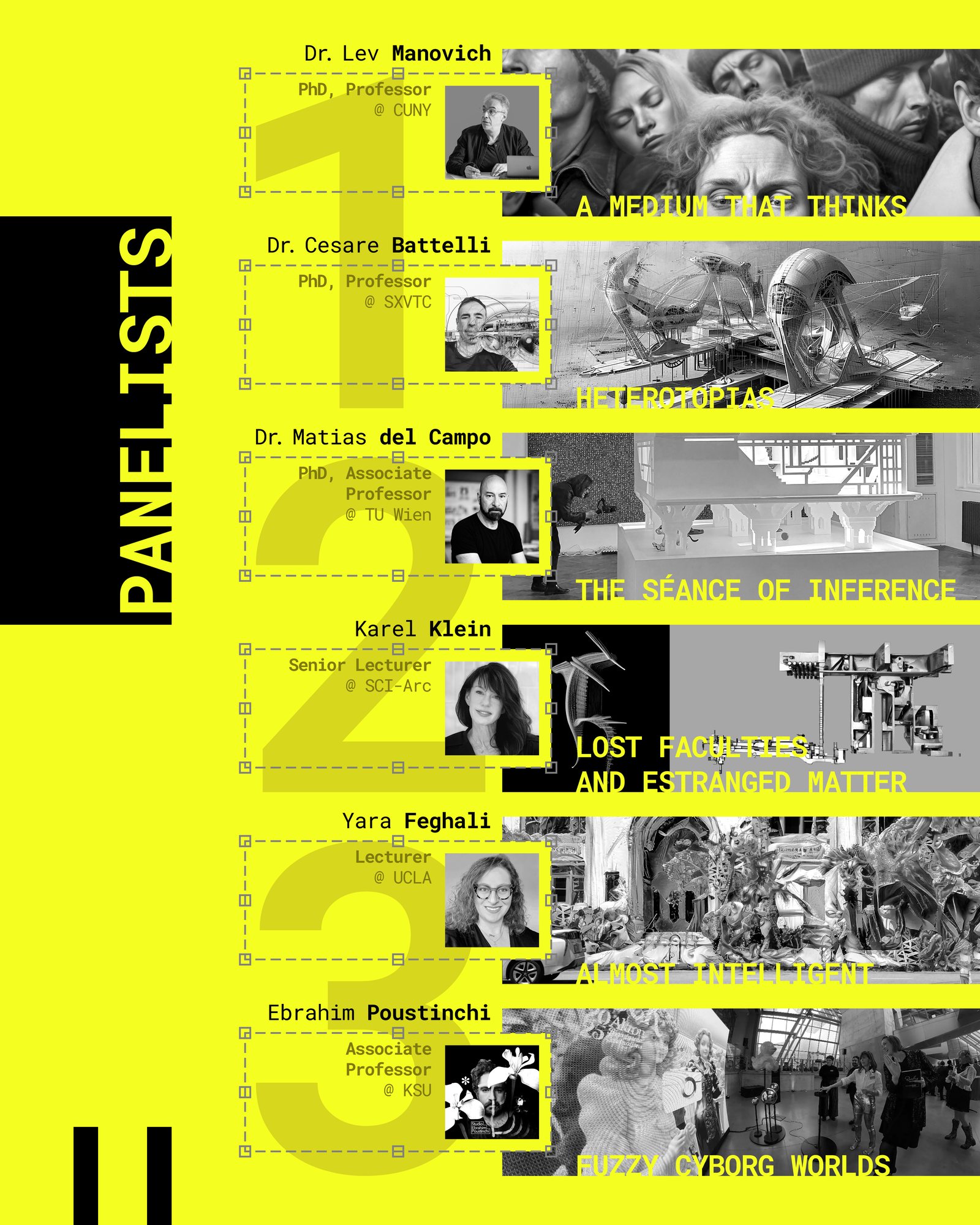
Speakers
Lev Manovich
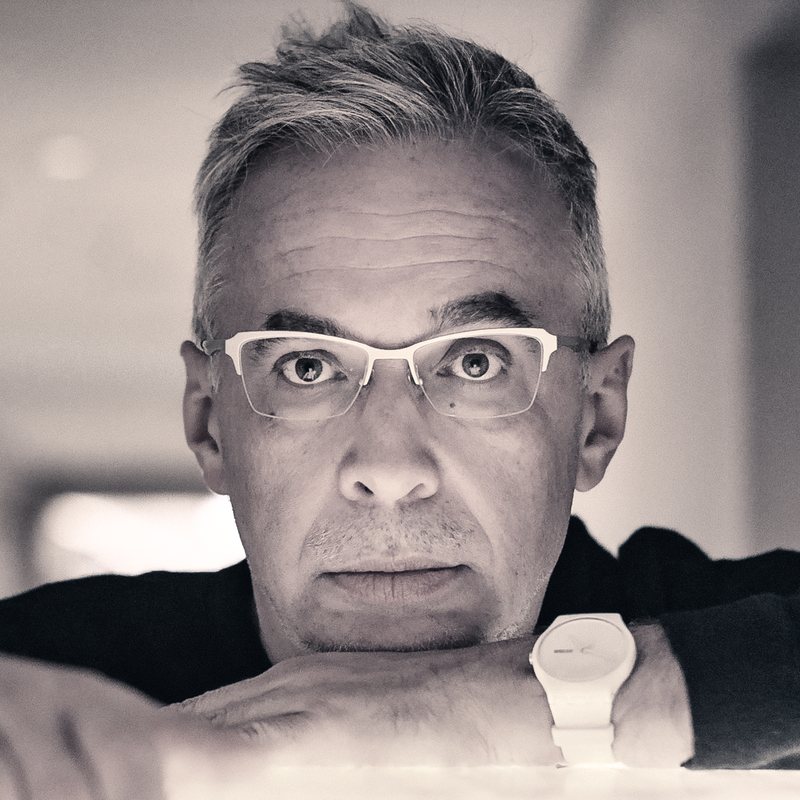
PhD, Professor @ CUNY − City University of New York
Biography
Dr. Lev Manovich is a Presidential Professor at The Graduate Center, City University of New York (CUNY). He is widely recognized as a pioneering thinker whose influential work in digital art, media theory, digital humanities, and visual culture continues to influence new generations of researchers. After studying painting, architecture, and filmmaking, Manovich began using computers to create digital art in 1984 and teaching it since 1991. Manovich has played a key role in creating a number of new research fields: new media and digital culture (1991–), software studies (2001–), cultural analytics (2005–), and AI aesthetics (2017–). His writings include 200 articles that are widely cited across multiple disciplines, reprinted over 650 times in 40 languages. Among his 17 books are Artificial Aesthetics, Cultural Analytics, Instagram and Contemporary Image, Software Takes Command, and The Language of New Media, which has been called “the most provocative and comprehensive media history since Marshall McLuhan.”
Manovich’s art projects have been exhibited in 14 solo and 124 international group exhibitions at many leading cultural institutions, such as the Institute of Contemporary Art (London), the Centre Pompidou, and the Shanghai Biennale.
Lev Manovich’s current research examines the aesthetic and cultural implications of generative AI, exploring how AI systems are reshaping the creation and interpretation of visual media. His work develops new theoretical frameworks for understanding AI as an artistic medium, building on his co-authored book Artificial Aesthetics: Generative AI, Art and Visual Media (2024) and his own art practice, which uses AI tools.
Lecture: A Medium That Thinks

This talk proposes a theoretical framework for understanding generative media – artifacts created or modified using GenAI tools. Unlike all previous artistic media, generative media thinks: it reasons, understands images, and possesses encyclopedic knowledge of art history, techniques, and the styles of thousands of individual creators – what we might call “media cognition.” At the same time, its outputs can be unpredictable, introducing degrees of freedom into creative practice that have no real precedent outside experimental traditions like Cage or the Judson Dance Theatre. Generative media also replaces the digital artwork’s lack of uniqueness with something new: not identical copies, but endless variations – a condition that fundamentally challenges existing notions of authorship and cultural value.
Cesare Battelli
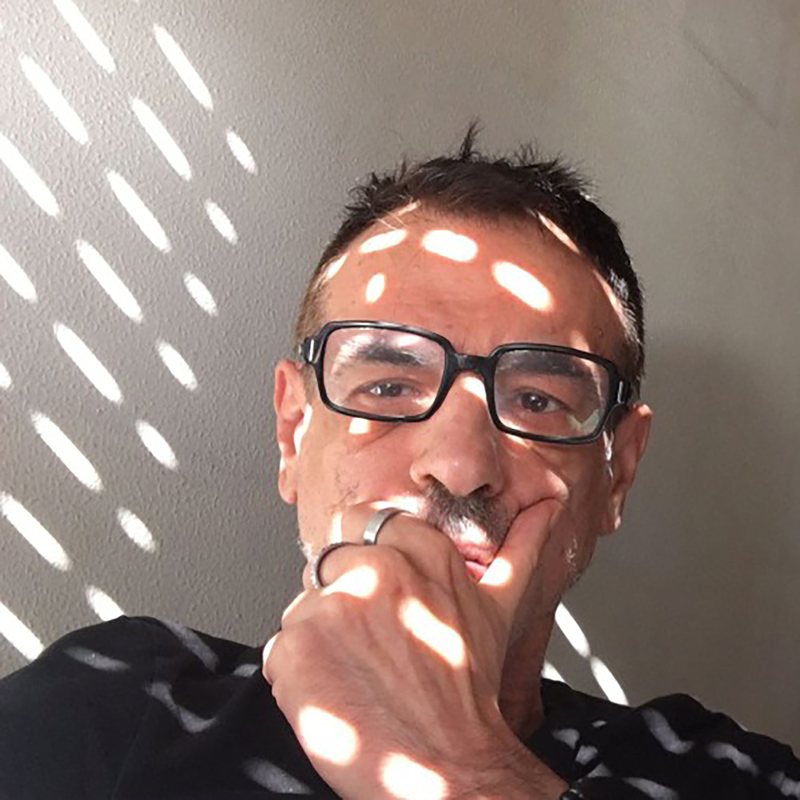
PhD, Professor @ SXVTC − Shaoxing Vocational and Technical College
Biography
Cesare Battelli is an Italian architect. His research focuses on visionary architecture and artificial intelligence, fields in which he experiments and develops projects at multiple scales. He has taught, conducted workshops, and served on juries at numerous universities, including Politecnico di Milano, IE, ETSAM, IUAV, the Architectural Association, GUC, and UBA, as well as curated international competitions.
He earned his degree at IUAV in Venice with a project developed in Moscow and completed a Master’s in Architecture at the Städelschule in Frankfurt, under the guidance of Enric Miralles and Peter Cook. He then obtained a PhD in Architecture at the Universidad de Alcalá de Henares.
In 2003, he founded the research platform Visionary-Architecture, maintaining collaborations with EMBT, with whom he worked on the project Nearly Ninety for Merce Cunningham, curated the exhibition 4 Cuartos, and contributed to several publications.
His projects, essays, and collaborations have appeared in journals such as El Croquis, Architectural Monographs (AD), Diseño Interior, Frame, Spazio e Architettura, and Architettura Cronaca e Storia, as well as on numerous digital platforms including ICARCH, Architect Magazine, The Conversation, Urban Signs, and Metalocus.
He is currently a researcher at the Universidad de Alcalá (UAH) in Madrid and Professor of Contemporary Architectural History at the Accademia di Belle Arti in Cuneo.
Website: visionary-architecture.com
Lecture: The Heterotopias of Artificial Intelligence
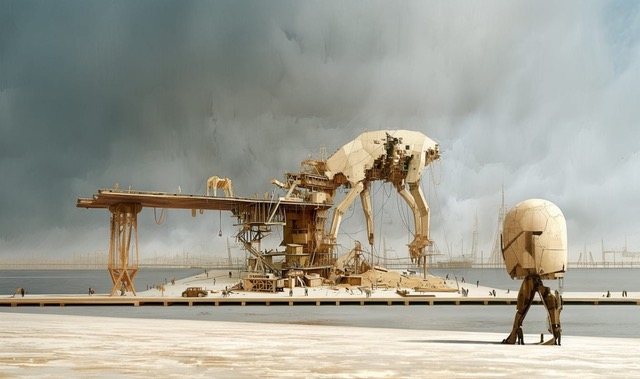
Artificial intelligence is often seen as a technical tool, focused on optimization and reproducing existing models. This lecture proposes a different view, reading AI as a contemporary heterotopia, a real but “other” space in which incompatible elements, displaced times, and latent forms coexist and interact.
AI operates as an active agent of imagination, where the prompt acts as a threshold between word and image. It is not a command with a fixed outcome, but an opening gesture that triggers visionary processes. The images and architectures generated emerge as apparitions, “spectral presences” that reveal worlds yet unseen.
Within this heterotopic space, architecture becomes a practice of emergence rather than construction. It is a field of possible worlds, inhabited by unstable, hybrid, and sometimes unsettling forms. AI assumes the role of a visionary agency, activating the emergence of other worlds and opening horizons that were previously unthinkable.
This approach invites a dialogue between human and machine, a shared exploration of thresholds where imagination and artificial generation meet. Ghosts inhabit this space, not as representations, but as manifestations of what has not yet fully appeared, turning the act of design into a visionary practice at the edge of the possible.
Matias del Campo
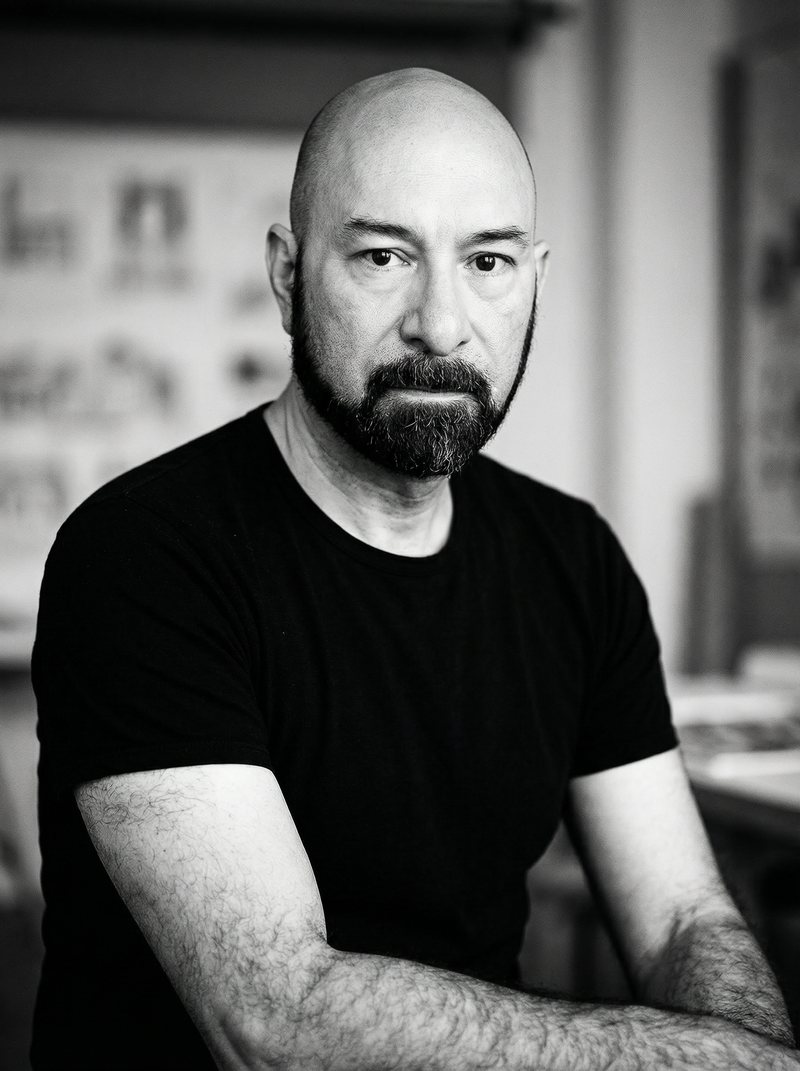
PhD, Associate Professor @ TU Wien − Vienna University of Technology
Biography
Dr. Matias del Campo is an Austrian architect, theorist, and co-founder of SPAN Architecture, a practice with offices in Vienna and Shanghai sustained by a long engagement with artificial intelligence, computational design, and the cultural dimensions of emerging technology. He is Professor at TU Wien’s Institute for Digital Architecture and Planning, resulting in a pedagogy that moves continuously between critical theory and live computation.
Through AKI GmbH – Angewandte Künstliche Intelligenz – he leads a Vienna-based company operating at the intersection of architecture, computation, and cultural analysis, translating speculative research into applied intelligence systems for industry and institutions. Recipient of the Accelerate@CERN award in 2015 and the ACADIA Innovative Research Award of Excellence in 2024, del Campo has developed a body of work that refuses the instrumentalist reduction of AI to a productivity layer, positioning it instead as a cultural technique, one that reconfigures how architecture thinks, generates form, and organizes knowledge.
His work is held in the permanent collections of the MAK Vienna, the Pinakothek München, the MAXXI Rome, and the Luciano Benetton Collection. He studied under Hans Hollein at the University of Applied Arts Vienna, completed his doctorate at RMIT Melbourne, and has authored Diffusions in Architecture (2024), Neural Architecture (2022), and Sublime Bodies (2017), with The Architects Manual to Artificial Intelligence forthcoming from Wiley.
Lecture: The Séance of Inference
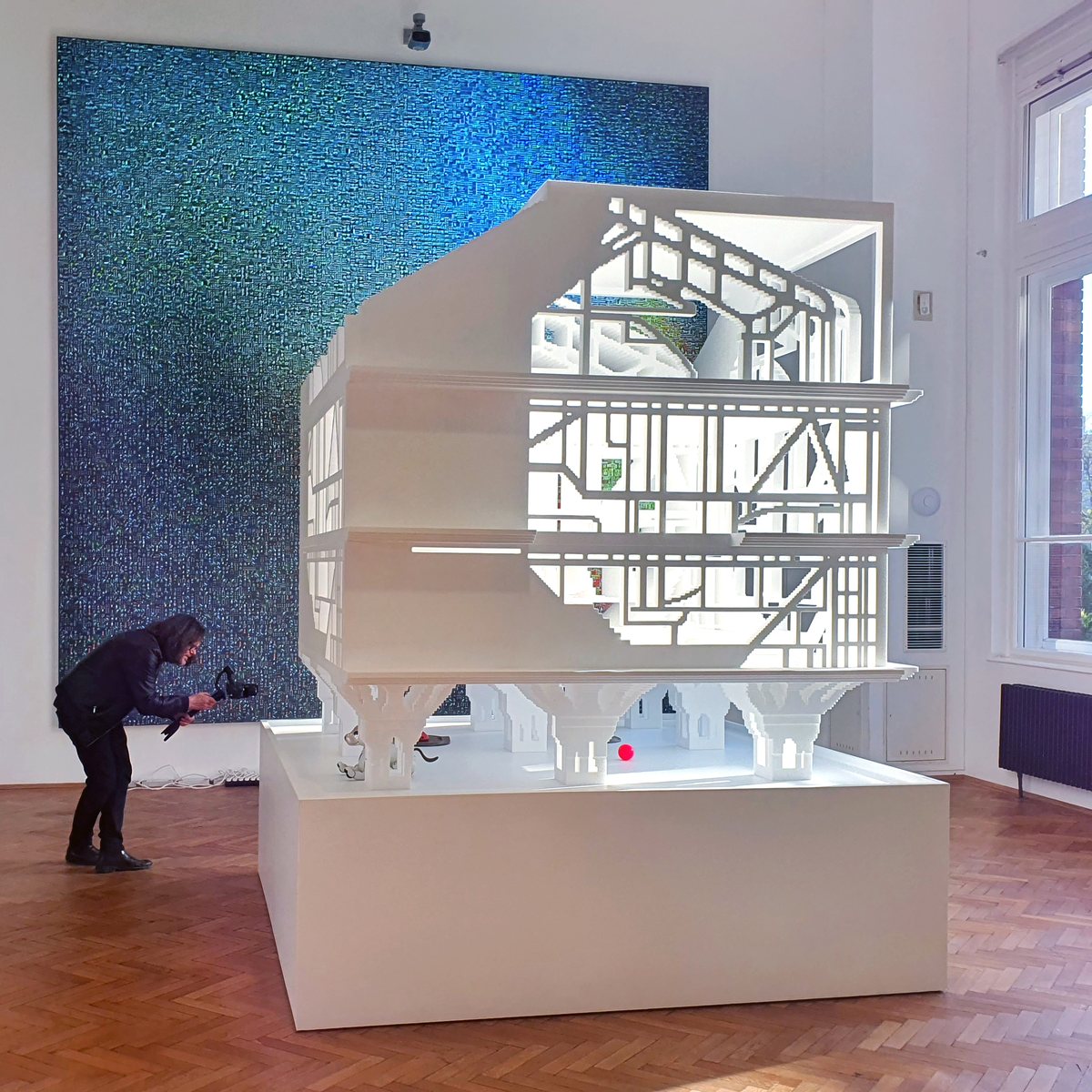
Architecture has always practiced a form of summoning – calling precedent forward, coaxing form from history, invoking the dead weight of typological memory – resulting in a discipline whose most decisive acts have always carried something ritualistic about them. The AI model makes this condition technically literal: compressed into high-dimensional territories, millions of built and unbuilt things wait in the latent space, available for evocation, returning as recombination, distorted by everything the model has absorbed, arriving always slightly other than called. Drawing on recent work in neural architecture, generative design, and probabilistic form-finding, this lecture develops the séance as a precise theoretical figure for AI-assisted design, arguing that inference operates less as computation than as conjuration, the architect presiding over a desk at which the entire history of built form is seated, willing to speak, impossible to fully control. The prompt is the incantation, the latent space, the darkened room, the generated output, the presence that answers – partial, unstable, inflected by training data the way a medium is inflected by whatever crosses through. Tracing this logic from classical theories of typological inheritance through contemporary diffusion models, the talk develops a theory of latent precedent as the operative condition of architectural inference, closing on the question of agency persisting when form arrives already haunted by its statistical origins.
Karel Klein
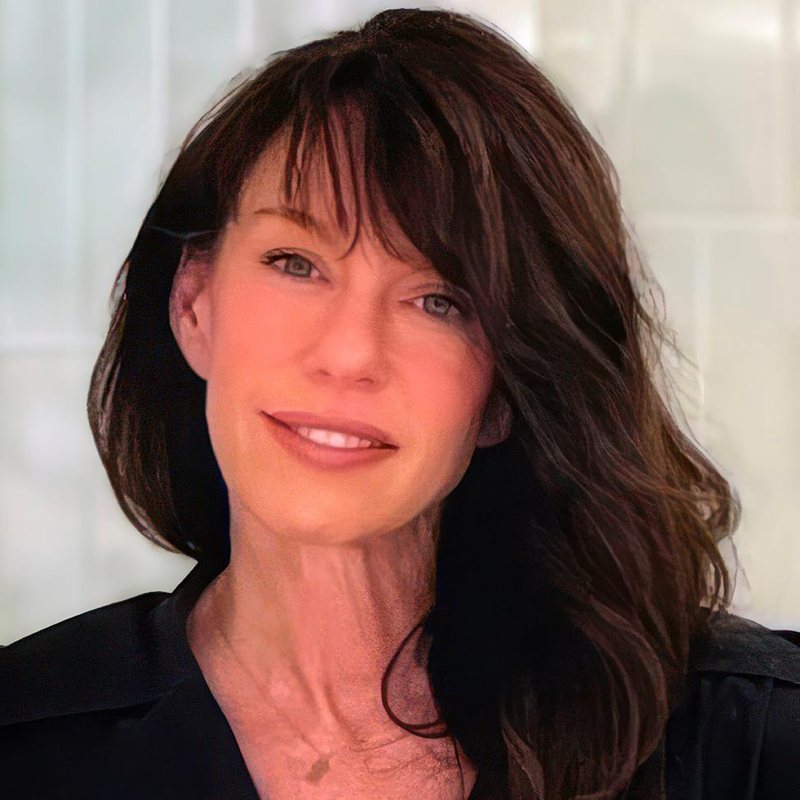
Senior Lecturer @ SCI-Arc − Southern California Institute of Architecture
Biography
Karel Klein is an architect and educator who has been working with various artificial intelligence (AI) technologies since 2016 and integrating them into her teaching since 2017. Her ongoing research employs deliberately estranging AI training methodologies – models trained on non-architectural systems whose organizational logics are then redirected toward architectural precedents. This work has moved from crossbred image-objects produced through atypically trained GANs to, more recently, LoRA-driven material migrations in which architectural elements acquire qualities from unrelated photographic sources. Her work investigates the capacity of AI-generated imagery for contemporary myth-making in architecture.
In the same way that imaginative vocabulary and metaphoric style were primary, if literary instruments for the invention of new mythologies for the Surrealists, the strange and idiosyncratic qualities of images produced using artificial intelligence are similarly a kind of matter metaphor-ed and made visible by the cyborg imagination. With these tools, Karel is interested in the re-enchantment of the architectural body – one that both foments and succumbs to sensual perceptions, and one that discovers new and unexpected relations to the world beyond the realm of the rational.
Her work in this domain has been exhibited at the Venice Biennale, 2021, the FRAC Institute, Orleans, France, Des Lee Gallery, St. Louis, and SCI-Arc Gallery, Los Angeles. Recent essays in pursuit of this work include “Verto Pellis,” in OffRamp, issue 17, “Machines are Braver than Art,” in Paprika/Rendering Fiction, Volume 7, Issue 08, and “Machines À Rechercher,” in Log 55, Summer 2022. Her most recent essay, “To Think a New Thing, AI, Metaphor and the Fantasies of Knowing,” was published in The Plan Journal 8, no. 2 (2023).
She is currently working on a book titled Reading What Was Never Written: Nonsensuous Similarities in Artificial Intelligence and Divinatory Practice. Recent lectures include “Material Migrations” at Cornell University and “Reading What Was Never Written” at the First Matter symposium, David R. Ravin School, University of North Carolina. Karel teaches at the Southern California Institute of Architecture (SCI-Arc) and Washington University in St. Louis.
Website: ruyklein.com
Lecture: Lost Faculties and Estranged Matter
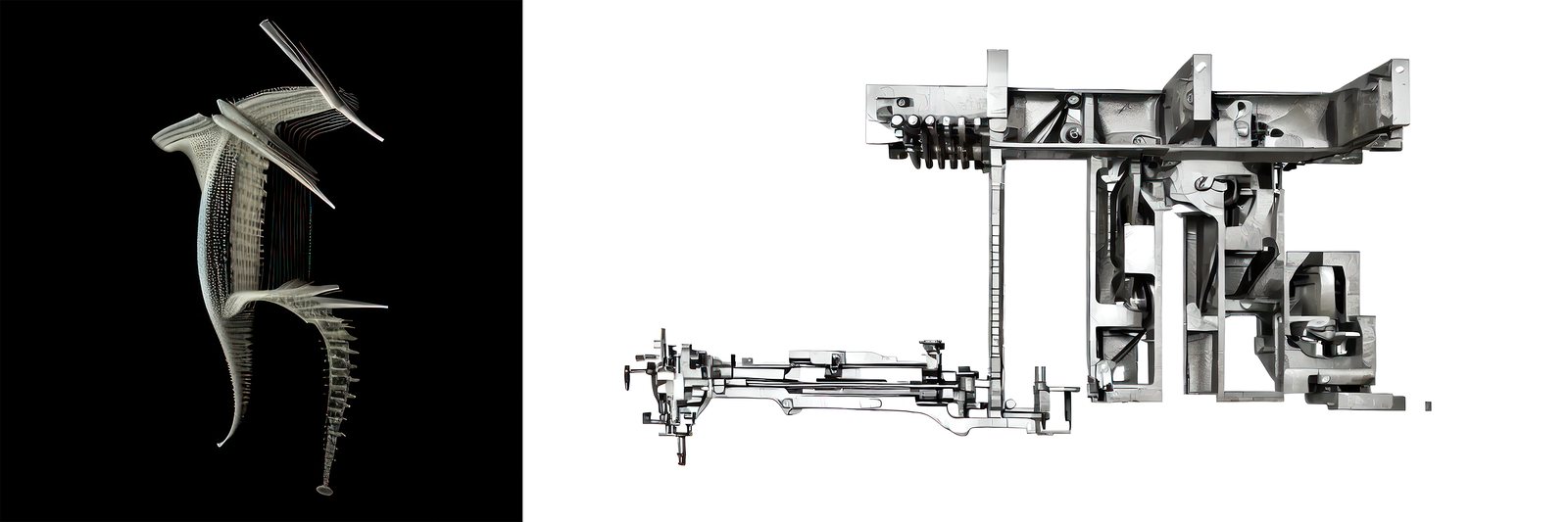
Walter Benjamin believed that modernity had caused the human mimetic faculty to atrophy. Our ancient capacity to perceive and produce resemblances, once central to divination and language alike, had gradually grown dim. This talk proposes that artificial intelligence has not replaced that faculty but recovered it, restoring something like the diviner’s ability to read pattern and correspondence where reason finds only coincidence: what Benjamin called the nonsensuous similarity.
The research behind this talk trains AI models on non-architectural systems: the resonating body of a string instrument, the skeleton of a fish, the mechanism of a sewing machine. Their organizational and material logics are then brought to bear on architectural matter. What returns is estranged, familiar in origin, unrecognizable in effect. The resulting image-objects are something closer to what the diviner reads, a pattern legible before it is understood.
“Lost Faculties and Estranged Matter” moves between Benjamin’s mimetic theory, contemporary divinatory practice, and an AI research methodology to ask what architecture stands to gain from images that arrive, like ghosts, from matter that was never meant to speak architecturally.
Yara Feghali

Lecturer @ UCLA − University of California, Los Angeles
Biography
Yara is a French Lebanese designer working at the intersection of architecture, video games, and immersive technologies. She is a Design Faculty at UCLA AUD, and the creative director of Folly Feast Lab co-founded with Viviane El Kmati based in Los Angeles, California. Viviane is a Lebanese programmer and the technology director working through coding, tech art, and AI technologies.
Through worldbuilding and storytelling they design immersive and interactive experiences, applications, software, design tools, and video games around queer identity, sustainability, and technology. Yara and Viviane are committed with Folly Feast Lab to designing fantastic experiences that are as aesthetically engaging as they are technologically performing.
Their XR work has been part of XR2C2 Cannes, MOMA AR, Onassis ONX, MIT ODL, Fiber Festival Amsterdam, A+D Museum LA, LA Forum, Ars Electronica + Thyssen-Bornemisza Art Austria, AD Magazine, Re-Fest Culture Hub, Cyberia Playground India, Cal Arts Visions 2030, MU Hybrid Art House, ZKM Germany, Pompidou Paris, and Art Science Museum Singapore. Yara and Viviane are both graduates from ALBA.
Website: yarafeghali.com
Lecture: Almost Intelligent
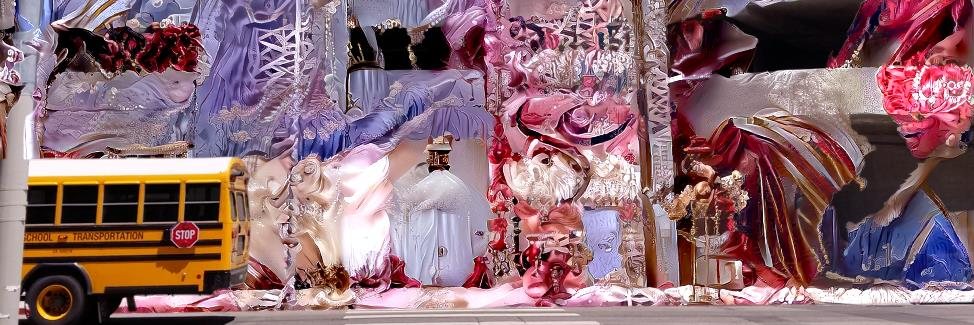
With the rise of generated content and AI slopes, we need to critically assess what these technologies’ repercussions are on our discipline. How do we adapt the design process within our classrooms? How do we teach the future designers to work with these new tools? And most importantly how do we engage and critically think through these tools. “Almost Intelligent” will act as a catalog of ways to work with these new tools. We will explore a variety of classes and content taught at SAC in Frankfurt, SCI-Arc and UCLA in Los Angeles over the last 10 years. Where do we go from here? What is the value of technical software expertise in design? How to assess future designs when they are generated by generic dominant visual patterns in dataset coming from a regime of statistical anticipation? Where does it leave us in terms of aesthetics?
Ebrahim Poustinchi
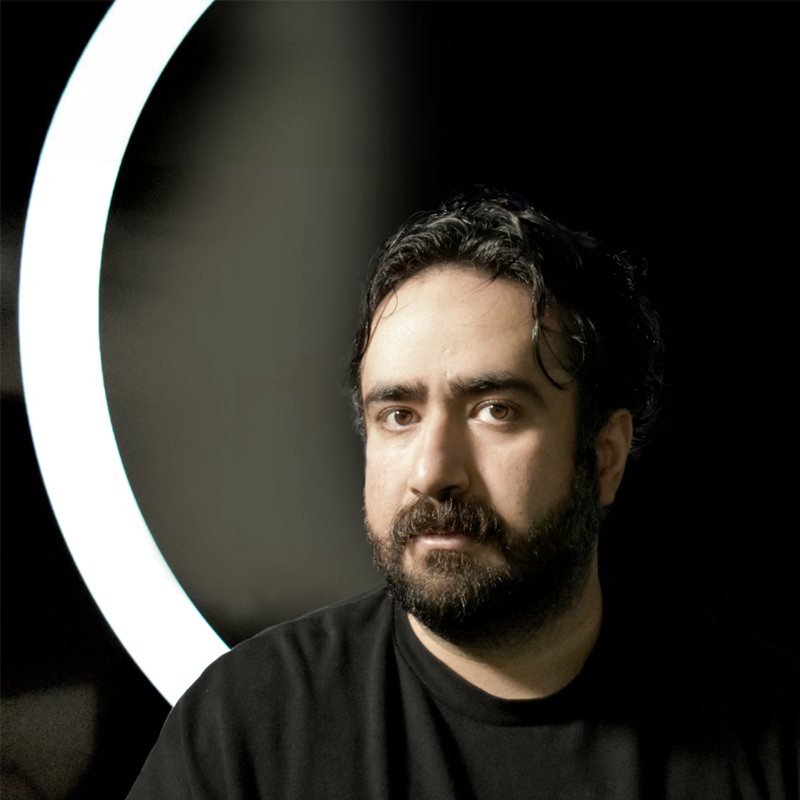
Associate Professor @ KSU − Kent State University
Biography
Ebrahim Poustinchi, an award-winning architect, artist/designer, and curator, is a tenured Associate Professor of digital design/architecture and the founder/director of the Robotically Augmented Design (RAD) Lab at Kent State University, and the founding principal of Studio EP, an experimental art/design practice.
Poustinchi’s work focuses on the intersection of design/art, worldbuilding, space, media, technology, AI, and robotics, with an emphasis on an alternative reading of Animism and human/non-human dialogue through cyber-physical public-art installations and video art, UI/UX design, Human-Machine Interaction (HMI), and tangible/accessible interfaces, to speculate on world(s) built/made/curated by/for human/non-human.
Ebrahim has widely lectured, taught workshops, and exhibited his work nationally/internationally. His work has been disseminated worldwide through various Journals, patented inventions, conferences and galleries/museums, including the Museum of Moscow and Meyerhold Theatre Center in Russia, Akron Art Museum, Akron Bicentennial Celebrations, Akron’s Contemporary Arts District, and Armstrong Gallery in Ohio, the Arab-American National Museum in Michigan, The Rubelle & Norman Schafler Gallery in New York, Stella Elkins Tyler Gallery in Philadelphia, Spazio Giustiniani Gallery in Italy, Jan-Koniarek Gallery in Slovakia, Fully-Booked Art-Fair in Dubai, and Levantine Cultural Center, and Architecture and Design (A+D) Museum in Los Angeles, and over ten different galleries/museums in Iran.
Poustinchi is the author/editor and art director of multiple books. His recent co-edited book, A Purple Architecture: Design in the Age of Physical-Virtual Continuum (Kerestes, Poustinchi, Vahdat 2024), published by Carnegie Mellon University ETC Press, was selected as the 2024 book of the year by the Next Generation Indie Book Awards in the art category.
Website: ebrahimpoustinchi.com
Lecture: Fuzzy Cyborg World(s)
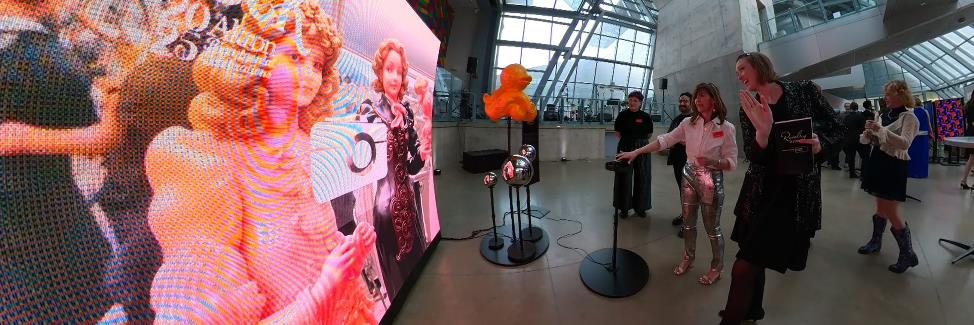
“In his book, The Second Digital Turn, Mario Carpo asserts that while the first digital turn in the early 90s visibly revolutionized design and making, the second digital turn has modified our thinking for the past decade (Carpo, 2017)*. Over the past few years, this modification has moved even further and potentially into our spatial/experiential perception and understanding.
…
While the majority of our spatial experience is – or at least has been – through physical interactions with space, it is evident that our perception of spatial reality has begun to become deeply synthesized during the past few years.”**
Focusing on the design research and cyber-physical speculative work of Ebrahim Poustinchi and Studio EP – spanning installations, exhibitions, AR/VR experiments, and custom-made creative AI frameworks – this lecture explores the intersection of architecture/space, technology, media, robotics, and non-human intelligence/agencies, as possible mediums for designing and experiencing alternative spatial world(s).
Grounded in Fuzzy Logic Theory – as a mathematical framework – and expanded through Poustinchi’s theory of Fuzzy Architecture, Fuzzy Cyborg World(s) aims to challenge the entrenched digital/physical and human/non-human binaries within the design and architecture discourse and discipline, provoking a spectrum of hybrid spatial and experiential in-between possibilities, with variable degrees of agency.
- * Mario Carpo. (2017). The Second Digital Turn: Design Beyond Intelligence. Cambridge, Mass.: The MIT Press.
- ** Poustinchi, Ebrahim. (2024). Fuzzy Architecture; A Purple Haze, in A Purple Architecture: Design in the Age of the Physical-Virtual Continuum, Kerestes, J., Poustinchi, E., and Vahdat, V. (eds.), Carnegie Mellon University ETC Press, 34-39.
Talks
Prof. Fadlallah Dagher – Overture
Hello everyone,
Welcome to the “Intelligent Things” webinar hosted by ALBA.
I would like to take this opportunity to acknowledge the ongoing work of Mr. Samer Eid in introducing and developing alternative ways of thinking through the use of new tools for design and expression.
I would also like to thank Dr. Ricardo Mbarkho, Director of ALBA’s Center for Research and Creation, who is hosting this initiative, encouraging it, and integrating it into the framework of academic inquiry and rigor.
Thank you to our six international speakers who, from the Far East to the Far West, will each share their interests, valuable knowledge, and ambitions, and to Gilles Chahwan for moderating these interventions.
Finally, thank you to Dr. Gaby Issa El Khoury, Director of the ALBA School of Architecture, for his encouragement and unwavering support for the education and personal growth of our students.
Artificial intelligence (AI) is part of a long history of celebrating the human mind. Long before circuits and neural networks, the Persian poet Ferdowsi celebrated reason in the 10th century as humanity’s treasure and compass, reminding us that wisdom illuminates action and elevates peoples. This poetic insight foreshadows the idea that intelligence – whether natural or artificial – is not merely an accumulation of facts, but the art of organizing, discerning, and anticipating.
A century later, another Persian, the mathematician al-Khwarizmi, laid the technical foundation for this endeavor. By systematizing algebra and computational methods, he bequeathed “algorithms” – a term derived from his name – that is, finite procedures for solving problems. Without these operational frameworks, there would be no programming, no machine learning, and no engines capable of extracting patterns from data. AI thus continues an age-old endeavor: transforming mathematical abstraction into operational power.
On a philosophical level, Descartes’s “I think, therefore I am” reminds us that thought is experienced through its own activity. AI, for its part, does not “think” like a conscious subject; it calculates, models, and anticipates. But the cogito invites us to question what we call thinking, and to distinguish between lived experience and functional competence.
Spinoza, finally, sees at the heart of life a dynamic of growth and perseverance in being. This idea inspires an ethics of AI: designing systems that augment our capabilities, promote the common good, and integrate harmoniously into our environments. At the intersection of poetry, mathematics, and philosophy, AI thus becomes a project of lucidity, method, and responsibility. It contributes to the expansion of our understanding of reality, from science to art and emotions.
Dr. Gaby Issa-El-Khoury – Keynote 1
Architecture and Artificial Intelligence: The True Potential of Artificial Intelligence
Ladies and Gentlemen,
Speakers and panelists,
Dear colleagues and fellow educators,
Dear students,
Today, we find ourselves at a defining turning point in higher education – and even more so in architectural education. Artificial Intelligence has already disrupted the academic landscape. We can no longer ignore its presence, nor its use – at times excessive – among students. The question, therefore, is no longer whether AI should be part of our teaching, but how we choose to engage with it.
Higher education has already weathered technological “revolutions” that challenged our pedagogical methods. Allow me to briefly mention two examples: the calculator, which replaced the slide rule and allowed us to go further in the study of sciences; and Computer Aided Design, CAD, which transformed – for students and professionals alike – the way we work and share design drawings.
You might argue that these two revolutions pale in comparison to the one brought about by AI – and you would be right. Yet in their own time, they were experienced as real shocks within the world of education. What feels unprecedented today often echoes transformations we have already learned to absorb.
The greatest fear stems from one central question: can AI replace the architect? This concern is understandable, because unlike previous revolutions, AI possesses a creative potential that those earlier disruptions simply did not.
Through Large Language Models, LLM, students can now watch their ideas transform into objects – what we call AI-Generated Content, AIGC. Hence the impression that the architect might become redundant. And yet, this impression deserves to be questioned. It is precisely the architect who feeds data into these models, and it is still the architect who critiques the outcomes of that intelligence. The student, like the professional, remains the final decision-maker – accepting or rejecting what the machine has created.
And this is where it gets fascinating. Who actually created that form? The human, through their analysis and the prompts they entered? Or the machine, which interpreted that input in its own way? Without claiming to settle the debate, I would say spontaneously: a little of both.
Educators tend to criticize their students for their overreliance on AI, while students have not yet mastered the relationship between their inputs and the outcomes they receive. What AI saves in time should allow students and professionals to reinvest that time – in refining their ideas, personalizing them, and truly making them their own. Used well, AI does not diminish authorship; it challenges us to redefine it. What we perceive as the exclusive work of AI should instead be understood and experienced as a close collaboration between AI and the user – whether student or professional – while acknowledging the control that humans must maintain over the machine.
Acknowledging the benefits of AI, universities in general, and ALBA in particular, can no longer afford to ignore this technology: they must integrate it into their curricula as swiftly as possible. This is not only a matter of keeping pace with technological change; it is a condition for remaining intellectually relevant. Not only is it necessary to step fully into the 21st century and its new technologies, but we can no longer hope to attract the next generation of students without them.
I now invite you to enjoy this webinar: Intelligent Things. The title is revealing in itself – things, by nature inert and devoid of any emotion, have today become intelligent.
Six speakers will guide you through this journey:
- Dr. Lev Manovich, Professor at the City University of New York, CUNY, will show that AI tools can “reason” and are capable of understanding and interpreting images.
- Dr. Cesare Battelli, Professor at Shaoxing Vocational and Technical College, offers a different perspective on AI, conceiving it as a contemporary heterotopia – real, yet existing in “another” space.
- Dr. Matias del Campo, Associate Professor at the Technische Universität Wien, TUW, will argue that AI-assisted design is a precise theory, not a matter of chance.
- Karel Klein, Senior Lecturer at the Southern California Institute of Architecture, SCI-Arc, reassures us that AI does not annihilate our ability to perceive and reproduce objects – on the contrary, it strengthens it.
- Yara Feghali, Lecturer at the University of California at Los Angeles, UCLA, and an ALBA alumna – which I could not fail to mention – offers what amounts to a practical catalogue of ways to work with these new tools.
- Ebrahim Poustinchi, Associate Professor at Kent State University, KSU, award-winning architect, and founder of the Robotically Augmented Design Lab, RAD, will close this webinar by integrating robotics and Augmented and Virtual Reality, AR/VR, into everything that will have come before.
I leave you now to enjoy, this afternoon, these six talks – which I am convinced will open new horizons – and new ways of working and thinking about space, in architecture and beyond.
Dr. Ricardo Mbarkho – Keynote 2
Good evening, everyone,
Since its establishment in 2023, the Centre for Research and Creation (The CRC of ALBA) has been working to support research and creation through a strong framework, critical reflection, and interdisciplinary exchange. The Centre was created as a place where artistic disciplines can meet one another, but also enter into dialogue with other fields of knowledge.
This is important because the arts do not stand outside society. They are part of it. They reveal its tensions, its transformations, its contradictions, and sometimes even its blind spots. Across history, artistic research and artistic practice have often questioned what a society takes for granted. They have challenged norms, opened new ways of seeing, and invited people to think differently.
Our role is to create conditions for questioning, experimentation, and critical engagement. At the CRC, uncertainty, doubt, and reflection are part of the process. They help us resist passive reception and encourage more active forms of thought and practice.
In this sense, the artist-researcher is not just someone who produces work. He or she also develops a position toward the world. The social and cultural environment becomes a field of inquiry, a source of hypotheses, and a site of intervention.
Because the CRC is based in Beirut, it gives special attention to the evolution of the creative sectors in Lebanon and to their social, cultural, and political implications. At the same time, it remains open to exchanges with international partners, research centres, and labs. This dialogue across contexts is part of our vision.
Tonight’s webinar fully belongs to this approach.
INTELLIGENT THINGS invites us to reflect on artificial intelligence as a transformation that is already affecting how we write, imagine, design, represent, and think. This concerns architecture and many other fields. It also concerns education, research, and the future of creative work itself.
The question, then, is not whether artificial intelligence is good or bad in itself. The real question is: what does it change in our relation to images, language, authorship, and thought? What happens to the act of creation when generative systems begin to participate in the production of forms? What happens to the role of the author, to the status of the project, and to the place of critical judgment?
These are not small questions. They ask us to think carefully, and also collectively.
This is why such a webinar matters. It creates a shared space for reflection. It brings together voices, approaches, and disciplines around an issue that is already reshaping many parts of our intellectual and creative lives. For instance, in the Lebanese context, it also raises questions related to security, surveillance, and the broader conditions within which technology is deployed.
I would like to warmly thank all those who helped make this event possible, as well as our speakers for joining us and sharing their work and ideas. I also thank the audience.
With our guests, let us expand the space for thought and discuss new paths for research and creation.
Thank you, and welcome.
Samer Eid – Introduction of the webinar
« Prompts ignite in the midnight grid. Hosts decode what the black glass hid. Ghosts survive in the spectral stream. And the circuit folds into a dream. Intelligent Things. Shadows that think. In the walls. In the wires. Built from ghosts and desires – We live among Intelligent Things. » [ I*T © 2026 ]
Good afternoon and welcome to all.
“INTELLIGENT THINGS | from prompts to ghosts” – is not just one catchy theme; it is a genuine posture. The latter finds solid anchor within a simple postulation; a subtle displacement in which ‘intelligence’ is no longer where we thought it was. It no longer resides in the exclusive author, nor in the tool, but circulates and fluctuates – fragmented and redistributed – across systems that think with us, beside us, and sometimes ahead of us. In this sense, the current initiative does not aim to instruct in usage, but to situate creative practices amongst broader grounds, where the boundaries between human and machine, the conceived and the computed, grow increasingly porous. A trilogy scheme feeds upon such infrastructure: three intertwined domains, statuses or key-figures; sequentially labeled – ‘Prompts’. ‘Hosts’. ‘Ghosts’. This dynamic triptych inflects synchronously through linguistic, operative, and spectral entanglements.
Prompts serve as point of entry. Accurate commands or triggering vectors, they establish directions, gradually enabling the models to interpolate, extrapolate, and generate throughout drifting workflows. To prompt is to engage with the very intricate grammar of the text, corresponding syntax and context. Cognitive constructions emerge from explicit instructions, performative gestures refract into embodiment, therefore mediating between language connotation and algorithmic depiction, in quest of nascent meaning. The prompt engineer becomes a designer of inputs, a strategist of iteration; a curator of trajectories.
At the core of this evolving paradigm – Hosts surface as active vessels. If prompts initiate processes, hosts sustain and materialize them. They are the simulated environments within which agency is enacted, channeling abstract computation into perceptible artefacts, intelligently mapping things and territories. The augmented user, aided by means of highly dexterous engines and resourceful datasets, glide and slide across diffusion signals and scenes, strata of co-production, bridging thereby the relational gap between human and nonhuman protagonists. Spatial protocols deploy, crystallizing towards speculative ecologies.
Ghosts are the ambient forces and hidden traces, underneath latent worlds. Echoes of expired typologies, layers of mnemonic imagery; residual patterns and segmented agents, recursive biases and memorial cues; they condense the intangible pedigrees of forms, with contorted genealogies. Not glitches or anomalies. Uncanny outputs thus manifest in atmospheric modulations, opaque tendencies, distortions and intensities; implicitly encrypted, via subconscious renditions. Sedimented altogether in a metadata-driven repository of accumulated histories, mute diagrammatic simulacra haunt cartographies of post-digital archaeologies.
That was for the narrative, in brief.
Before we proceed, I would like to extend few words of gratitude – to the ALBA Dean, Prof. Fadlo Dagher; to Dr. Gaby Issa-El-Khoury, Director of the School of Architecture; to Dr. Ricardo Mbarkho, Director of the Centre for Research and Creation, and co-organizer of this event; one final mention goes to Gilles.
Dear ALBA students and colleagues, this webinar offers us a theoretical premise, a curatorial stance, and most importantly – the lucid realization that those “INTELLIGENT THINGS” already affect our futures. Thank you all for being here, despite the challenging circumstances – Now, I hand over to Dr. Mbarkho.
Dr. Ricardo Mbarkho – Introducing Dr. Lev Manovich
Good afternoon,
Introducing Lev Manovich means situating a voice that has impacted how we think about media for more than three decades.
He is Presidential Professor at the Graduate Center of the City University of New York. His background moves across painting, architecture, filmmaking, and computation. He began working with digital media in the early 1980s, long before it became a dominant field, and has been teaching it since the early 1990s.
Across this trajectory, he has contributed to the formation of several key areas: new media studies, software studies, cultural analytics, and more recently, the study of AI aesthetics. His work is widely read and translated, with hundreds of publications and a series of influential books, including The Language of New Media, Software Takes Command, and more recently Artificial Aesthetics.
What is important here is not only the quantity of work, but its position. His writing does not simply describe technological change. It proposes frameworks to understand how culture itself is reorganized through media. His artistic work follows the same direction. His projects have been exhibited in major institutions such as the Centre Pompidou and the Shanghai Biennale. This double position, as both theorist and practitioner, gives his work a particular clarity.
In his lecture, A Medium That Thinks, Manovich proposes a shift that concerns all of us.
He suggests that generative AI is not just another tool. It behaves as a medium that can process, interpret, and generate content with a form of internal logic. It draws from vast histories of images and styles, and produces outputs as continuous variations rather than identical copies. This has direct consequences.
Authorship becomes less stable. The role of the creator changes. The work is no longer fully controlled from the beginning to the end. It emerges through an interaction.
Within this context, the prompt takes on a new role. It opens a process in motion without fully defining what will emerge from it.
What is at stake is a new relationship between thinking and making. Media ceases to be a mere channel. It becomes an active part of thought itself.
Lev Manovich, welcome.
Dr. Ricardo Mbarkho – Introducing Dr. Cesare Battelli
We now turn to Cesare Battelli.
Cesare Battelli is an Italian architect and researcher working at the intersection of architecture and artificial intelligence. His work develops through projects, teaching, and a long-term research platform called Visionary Architecture, which he founded in 2003.
He studied architecture at IUAV in Venice, developed work in Moscow, and later completed a Master’s at the Städelschule in Frankfurt under Enric Miralles and Peter Cook. He then obtained a PhD in architecture in Spain. His career includes teaching, workshops, and juries at institutions such as Politecnico di Milano, the Architectural Association, and other international schools. His projects and writings have been published in journals like El Croquis, Architectural Design, and Frame, as well as widely shared on digital platforms. He is currently active as a researcher and professor, continuing to develop work that moves between theory and speculative design. What defines his position is a clear shift in how architecture is understood.
In his lecture, Heterotopias, Battelli proposes to read AI less as a tool for efficiency than as a space. A space where different times, forms, and possibilities coexist. This idea comes from the notion of heterotopia. A space that contains multiple realities at once, without reducing them to a single order. Within this framework, AI becomes a place where architecture moves beyond conventional design. It appears, transforms, and sometimes resists definition.
The role of the prompt changes here as well. It is no longer a command producing a fixed result. It acts as a threshold, a point of passage between language and image.
The outputs that emerge from AI carry a specific quality. They are not fully stable objects. They appear as traces, as forms that suggest other possible worlds without fully resolving them. This leads to another shift.
Architecture is no longer only about building. It becomes a practice of emergence. The architect composes and navigates within a field of possibilities.
Placed next to Manovich, this position extends the discussion. From a medium that thinks, we move toward a space where worlds take shape.
Cesare Battelli, welcome.
Dr. Ricardo Mbarkho – Questions to Dr. Lev Manovich and Dr. Cesare Battelli
If architecture appears mainly as image, what does it become?
Can it still be understood as architecture when it circulates more through renders, screens, and visual speculation than through construction? Where do we draw the line between architecture and visual fiction?
What does the algorithm change in the way we think and imagine?
Does it reveal new possibilities, or does it impose its own logic on what can be produced? Is AI opening imagination, or narrowing it through repetition and prediction?
Samer Eid – Introducing Dr. Matias del Campo
We entered a site – inferential or interferential?
A comprehensive field where images, forms and spatial structures seamlessly merge with statistical memory. Therein, from tool to milieu, Artificial Intelligence infiltrates the architectural discipline, re-informing its epistemological scope. Dr. Matias del Campo thoroughly cultivates within this threshold.
Trained under the eminent Hans Hollein at the University of Applied Arts Vienna, and later completing his doctorate at RMIT Melbourne, Dr. del Campo is both practitioner and theorist. Co-founder of SPAN Architecture, his pioneering office spans across Vienna and Shanghai, combining advanced technology and philosophical inquiry, with a focus on “voluptuous data”, machine learning and AI-driven design methods. Professor at TU Wien’s Institute for Digital Architecture and Planning, and CEO of Angewandte Künstliche Intelligenz, he consistently maneuvers at the confluence of speculative research and operative intelligence systems.
Matias del Campo resists consuming AI as mere automation, reframing it instead as a cultural condition, in which intelligence is embedded, distributed, and always in formation. Precedent is no longer referenced in the linear historical sense, but compressed and encoded into high-dimensional spaces, reanimated as latent possibility. Within this framework, models are not basic means of output, but epistemic devices that reshape how architectonics are rationalized, assembled and remembered. Hence, the morphological act develops less as a routine of calculation, more as a process of solicitation revealing summoning momenta; relentless negotiations with vast, invisible archives of built and unbuilt worlds, where every product carries traces of innumerable lineages, transmuting toward a relational lattice of destabilized artefacts beyond recognition. What emerges is neither solely authored, nor entirely autonomous, but disperses in probabilistic synthesis across human and machine, inside a complex continuum of computational becoming.
Recipient of the Accelerate@CERN Award [2015] and the ACADIA Innovative Research Award of Excellence [2024], del Campo’s work is held in institutions like the MAK Vienna, the Pinakothek München and the MAXXI Rome. Resolutely constructed over series of projects along with pedagogical experiments, Dr Matias del Campo’s compendium includes robust publications such as: “Sublime Bodies” [2017], “Machine Hallucinations” [2022], “Neural Architecture” [2023], and “Diffusions in Architecture” [2024], with “The Architects Manual to Artificial Intelligence” forthcoming. An ontological apparatus for understanding generative protocols, not only as language patterns, but as active intellectual forces that constantly rescript the multilayered affiliation between instrument and environment via prior knowledge. Computation converted to conjuration.
A stitched passage from Jean Baudrillard’s “Simulacra and Simulation” [1981] enhances the previous equation:
« Simulation is no longer that of a territory, a referential being, or a substance, but the generation by models of a real without origin or reality: a hyperreal. The simulacrum is never what hides the truth; the simulacrum is true. It is no longer a question of imitation, duplication, nor even parody. There is no longer any referential: the real has been abolished, leaving only its operational double. The territory no longer precedes the map, nor survives it – henceforth, it is the map that precedes the territory. »
Through “The Séance of Inference” – Dr. del Campo traces a dynamic route, from evocation to invocation. Here, the prompt becomes an incantation; the medium, a host for odd elucubrations; extensive ecologies of ghostly manifestation. We entered this site – at once interferential and inferential – flowing with substantial apparitions, endowed with multiple registers. We are no longer alone in the deeds of making. Something else insists, suggests, deviates. Something, altered. Something, displaced. Something, other. An irreversible entanglement, where the human is no longer distinct from the posthuman it has beckoned. Now, we all gather – to listen to what is inferred.
Samer Eid – Introducing Karel Klein
We lost something – not intelligence, but attunement.
The ability to sense emotional resonance before reason, to read the world as signal rather than statement. Modernity traded that faculty for clarity. Artificial Intelligence, strangely, tends to give it back: misaligned, unstable, unreadable, yet, propitious. Karel Klein furtively operates inside such a rupture.
Academically trained on engineering precision and architectural speculation – beginning at the University of Illinois and sharpened at Columbia’s GSAPP during its early 90s’ “paperless studio”, Klein’s trajectory has continuously moved along a fault line tangled in between structure and imagination, system and drift. Today, as co-director of Ruy Klein in Los Angeles and a faculty member of SCI-Arc (Southern California Institute of Architecture) and WashU (Washington University in St. Louis), her practice unfolds across design, pedagogy and research, as a constant investigation of how avant-garde architecture might think.
Karel Klein does not use AI to optimize form or accelerate production. She misuses it, deliberately. Since 2016, her alchemical experiments have relentlessly trained models on ‘things’ architecture is not: myriads of items, trivial instruments and anatomies – funneled into re-enchanted architectural bodies. What emerges is a field of estranged image-objects in limbo; all too familiar in trace, alien in effect. There, displaced memories flicker via metaphysical transfers, not as references, but as reincarnations.
Formerly hosted within (mis)trained styleGANs (Generative Adversarial Networks) then more recently based on LoRA-driven datasets (Low-Rank Adaptation), morphological assets acquire material textures, behaviors and atmospheres of novel worldbuilding. A digital cabinet of curiosities, deliriously reconfigured with a menagerie of mutant taxonomies, ornamental artefacts, exquisite crossbreeds, and spectral chimeras, narrating new myths-in-becoming. Shapeshifting encounters of a ritualistic kind, “they are the frozen moments of deconsecration, the surrealist games of automatic (automated) writing; spontaneous and meaningless, disturbing and enchanting”. Quoting Steve Baker’s excerpt from “The Postmodern Animal” [2000]:
« The object – I cannot give it a better name – was discovered in a dimmed corner of a room filled with other objects one might simply call ‘curiosities’. This object had many visible qualities of an animal but was assuredly not one. Eyes without a face. Musculature beneath tufted fur, yet wooden, intricately carved limbs. Furniture-like arms and legs. The purpose of the object was unclear. It appeared useless. I wondered about its meaning. Was it also meaningless? I did not know this object’s identity nor its provenance. I decided to take this object with me to learn its story and failing that, to invent one. »
Chronologically exhibited at SCI-Arc Gallery [2017], FRAC Centre d’Orléans [2019] and the Venice Biennale [2021], Klein’s works are progressively supported by a series of theoretical essays including “Verto Pellis” [2020], “Machines are Braver than Art” [2022], “Machines à Rechercher” [2022], “To Think a New Thing: AI, Metaphor and the Fantasies of Knowing” [2023], and a current book in the making, titled “Reading What Was Never Written: Nonsensuous Similarities in Artificial Intelligence and Divinatory Practice”. Her AI-corpus articulates an adamant aesthetic – as a cognitive engine for immersive scenographies, rendering unmapped realities.
Klein’s lecture “Lost Faculties and Estranged Matter” – to be performed shortly within our ALBA webinar “Intelligent Things | from prompts to ghosts” – navigates and probes this ambiguous terrain: intelligence, not as property but as migration; not authorship, but distributed agency; not vision, but a recalibration of perception itself. We lost something – not intelligence, but attunement. What returns is not what was lost. It is stranger than that. A faculty that does not explain the world but makes it shimmer again. A prolific machination built on error and excess, where architecture is no longer composed, but divined.
Now, we are all eyes and ears for the goddess to sing.
Samer Eid – Questions to Dr. Matias del Campo and Karel Klein
Opening frame
I would like to begin by expressing my deep admiration for both of you – not only in terms of intellectual acknowledgment, but for the impact across academic contexts and within the international avant-garde. What is especially compelling is how each of your practices engages AI not just as a toolset, but as a way of rethinking what architecture can be. We have heard two distinct positions: one framing AI as a synthesis of latent systems; the other evolving as a site of misuse, distortion and perceptual attunement. Both of you seem to suggest that something elemental has shifted: not just how we design, but what it means to discern, to enquire, and to conceive. I would like to articulate our next conversation around three key-notions: intelligence, pedagogy and collateral ‘things’ – in order to reflect on the points where your trajectories converge and where they quietly diverge – with one central question in mind: what should we be teaching the next generation of architects in this condition? Ready for the discussion?
Core question #1 [ intelligence ]
- A common kick-start question: How do you each define intelligence in your respective practices, especially when distributed between human cognition and computational systems? Consequently, how could we understand intelligence today when learning – or teaching within arts and architecture?
- A direct follow-up: Where do you locate the momentum when intelligence comes to be architectural?
Core question #2 [ pedagogical speculation ]
- What could architecture education become in tandem with AI – not just as content, but as structure, ethics, and purpose? What should education focus on the most: outcomes, processes, or systems literacy? What are the essential skills, the new fundamentals – students need to acquire nowadays?
- What role should experimentation, ambiguity, or intuition play in education – should these be protected or persecuted? How can academic institutions boost this devoid of sabotage or limitation?
- How do you teach students to remain critical, while working with those inherently opaque systems?
- Do your approaches suggest shared pedagogical strategies, do they reinforce each other, or are they categorically pointing toward drastically opposed design cultures, or architectural futures?
- What should we actually stop teaching, or – put inversely – what maybe should students unlearn?
Core question #3 [ collateral things ]
- Here comes the unavoidable cliche: is authorship still a meaningful concept, or should it be promptly replaced with distributed agency? Is mastery about maintaining coherence or instability? Is the human figure still central to architecture or just one agent among many? Pushing further: if something problematic emerges from our system, who is accountable? The machine, no one or us?
- Are we still designing objects, or have we toppled from now on, into petty manipulators of systems that breed variations of objects? Are we still accessing knowledge or producing it retroactively? Rephrasing: Does our role suddenly swing from author to curator of system behavior? How do we ensure that students do not fall into passive users of engines, but survive as prolific designers?
- A technical question I lately ask myself: is AI eventually bringing the death of former software?
Closing frame
What emanates from this conversation is ultimately not a fixed model nor a single position, but a set of tensions and contingencies, trapped between synthesis and misalignment, inference and attunement, system and deviation, control and emergence. Perhaps the most significant task for future architects is not how to resolve these tensions – but to learn how to juggle with them. Karel, Matias, thank you both.
Screenshots
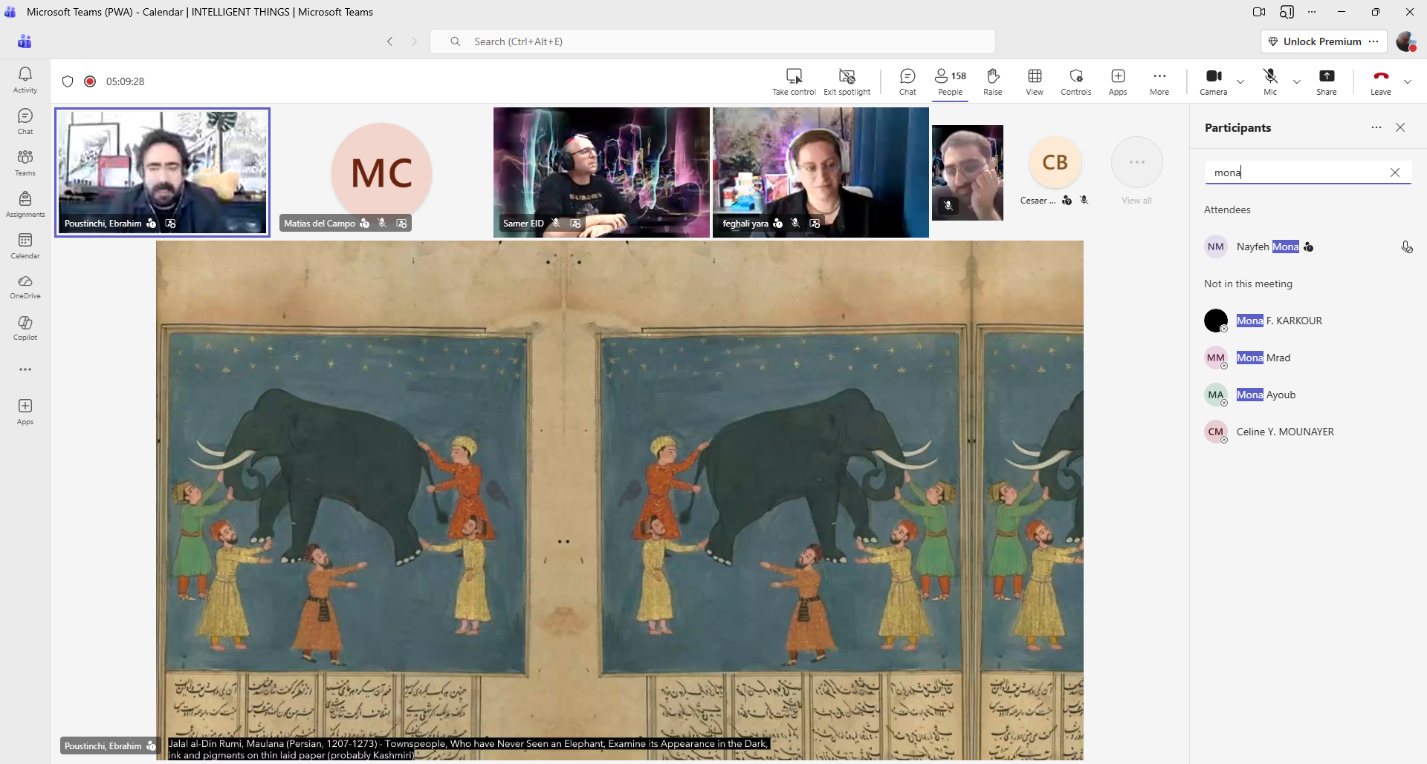
Photos